As AI systems mature, a clear shift is happening:
From single-model prompts to structured, collaborative AI systems
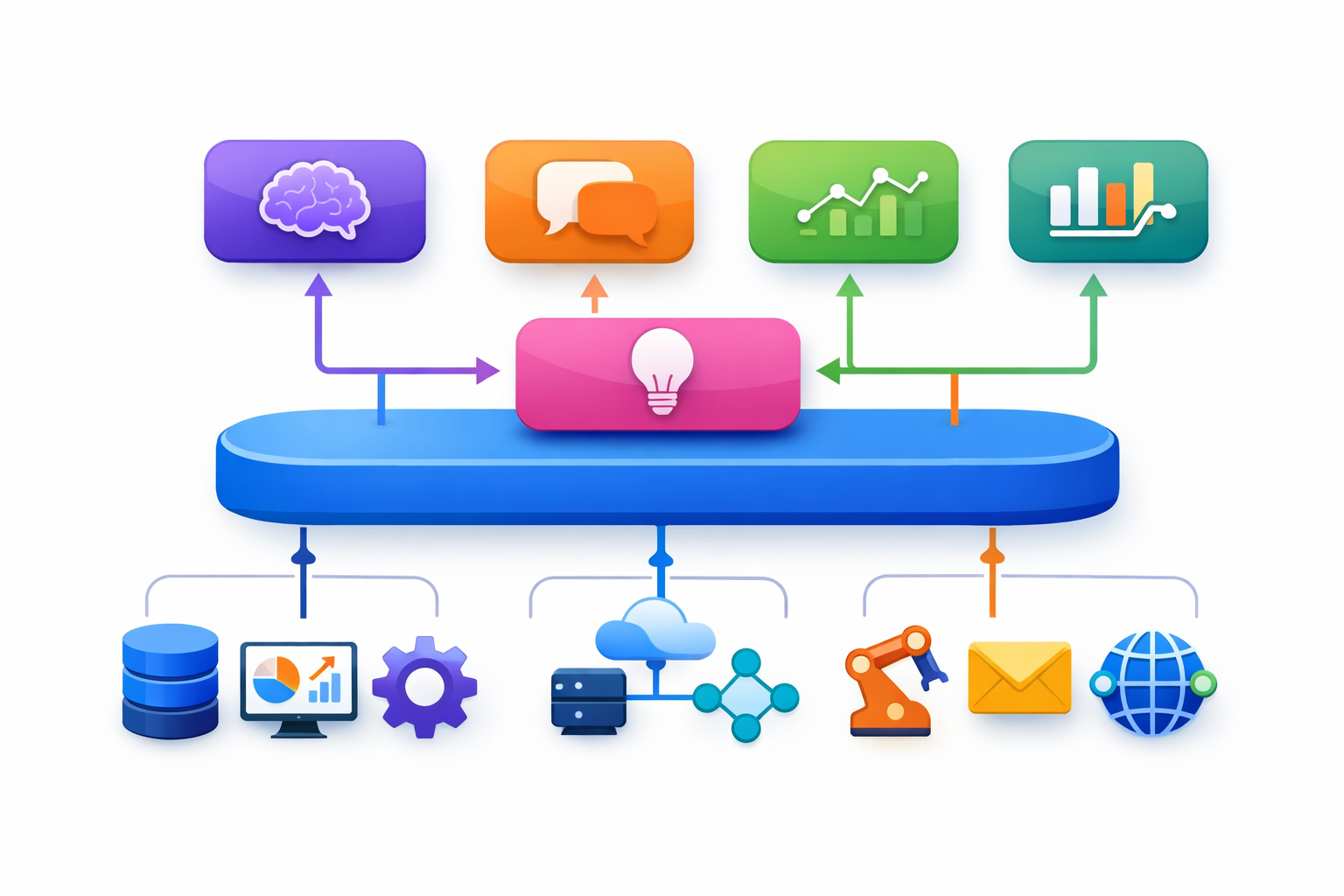
This shift is powered by multi-agent architectures – systems where multiple AI agents work together, each with defined roles, responsibilities, and tool access.
What Is a Multi-Agent Architecture?
A multi-agent architecture is a system design pattern where:
- Multiple AI agents operate independently
- Each agent has a specific role
- A coordination mechanism manages task delegation
- Agents may use tools or APIs
- Outputs are validated and combined
Instead of a single LLM handling everything, intelligence is distributed across specialized agents.
Think of it like a structured team:
- A Research Agent gathers data
- A Planner Agent creates a strategy
- An Executor Agent performs actions
- A Reviewer Agent validates results
This division improves reliability and clarity.
Why Multi-Agent Systems Are Rising
Single-prompt AI systems struggle with:
- Long workflows
- Multi-step reasoning
- Tool chaining
- Error recovery
- Role specialization
Multi-agent architectures address these by introducing:
- Separation of concerns
- Clear task boundaries
- Reduced cognitive overload per agent
- Controlled orchestration
As AI systems move from “assistive” to “operational,” structure becomes critical.
Core Components of a Multi-Agent Architecture
1. Coordinator / Orchestrator
This component:
- Assigns tasks
- Determines sequence
- Monitors progress
- Handles retries
It ensures flow control.
2. Specialized Agents
Each agent:
- Has a defined role
- Operates under specific instructions
- May use different models
- Has limited permissions
Specialization reduces hallucination and improves precision.
3. Tool Layer
Agents may interact with:
- Databases
- APIs
- Search engines
- CRM systems
- Internal services
This makes AI actionable rather than conversational.
4. Validation & Guardrails
Production systems require:
- Output validation
- Rule checks
- Human-in-the-loop review
- Logging and traceability
Without this, autonomy becomes risk.
Multi-Agent vs Single-Agent Systems
| Feature | Single-Agent | Multi-Agent |
| Simplicity | High | Moderate |
| Control | Limited | Strong |
| Role Specialization | No | Yes |
| Workflow Structure | Minimal | Clear |
| Scalability | Limited | High |
| Debugging | Hard | Easier if structured |
Multi-agent systems trade simplicity for control.
Where Multi-Agent Architectures Make Sense
Strong Use Cases
- AI-native SaaS platforms
- Complex research automation
- Financial workflows
- Legal document analysis
- Compliance systems
- AI-driven operations
- Customer support automation
Weak Use Cases
- Simple summarization
- One-step prompts
- Lightweight content generation
- Early experimentation
Complexity must match need.
Architectural Patterns in Multi-Agent Systems
1. Hierarchical Model
A top-level agent delegates to sub-agents.
Common in structured business workflows.
2. Sequential Pipeline
Agents operate step-by-step in a defined chain.
Useful in RAG and content systems.
3. Parallel Collaboration
Multiple agents work simultaneously and merge results.
Good for research or comparison tasks.
4. Event-Driven Model
Agents react to triggers and events.
Used in AI-native SaaS automation.
Cost & Performance Implications
Multi-agent systems increase:
- LLM calls
- Token usage
- Latency
- Infrastructure load
Organizations must implement:
- Model routing
- Cost tracking
- Caching strategies
- Observability layers
Without governance, cost scales unpredictably.
Governance & Enterprise Readiness
In 2026, AI governance is mandatory.
Multi-agent systems should include:
- Audit logs
- Agent permission control
- Role-based constraints
- Model version tracking
- Escalation mechanisms
AI teams are becoming structured – and so must AI systems.
Multi-Agent Architectures in SaaS
For SaaS companies, multi-agent systems enable:
- Autonomous onboarding workflows
- Intelligent support routing
- AI-assisted product analytics
- Automated report generation
- AI-driven feature orchestration
But they must be integrated with:
- Clean backend architecture
- API-first systems
- Observability
- Cost governance
Multi-agent design amplifies architecture discipline.
Common Mistakes to Avoid
- Adding too many agents too early
- Ignoring cost tracking
- Allowing agents unrestricted tool access
- Treating agents as autonomous without oversight
- Failing to define role boundaries
Multi-agent systems require intentional design, not experimentation alone.
The Strategic Shift: AI as Structured Infrastructure
Multi-agent architectures signal a shift:
From:
Prompt engineering
To:
Process engineering
From:
Single-call AI
To:
Coordinated AI systems
This is how AI becomes operational infrastructure.
Final Thoughts
Multi-agent architectures are not a trend – they are a structural evolution in AI system design.
They enable:
- Specialization
- Controlled delegation
- Workflow clarity
- Scalable automation
But they require:
- Strong system architecture
- Cost governance
- Observability
- Engineering maturity
Competitive AI systems are not defined by model size alone, but by how intelligently their intelligence is structured. Multi-agent architectures are one of the clearest signals of that evolution.