
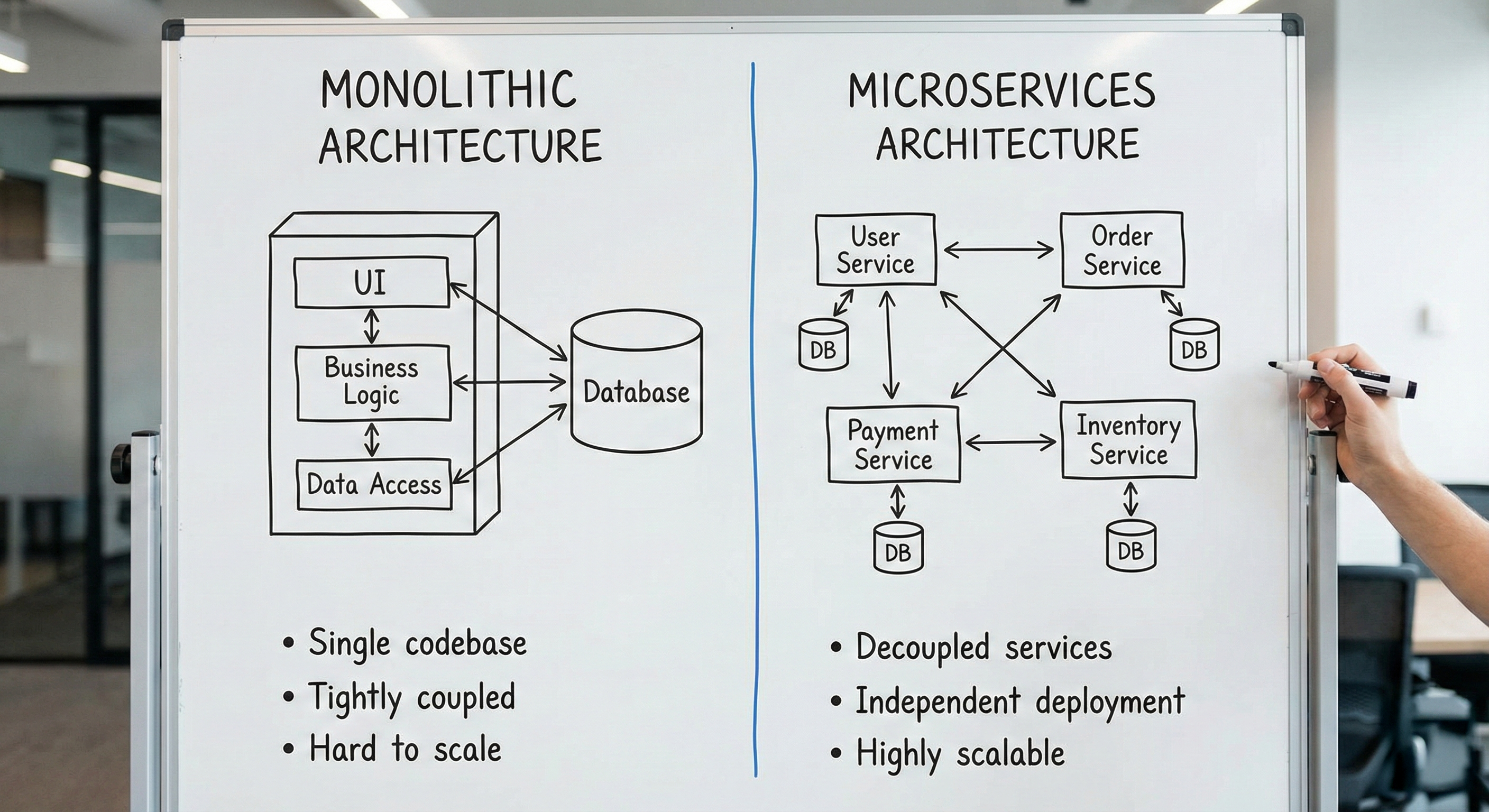
Choosing the right architecture for your product is one of the most important decisions your startup will make. Whether you adopt a monolithic structure or move towards microservices, the choice directly impacts development speed, scalability, long-term maintenance, and overall engineering efficiency.
Both architectures are proven and widely used across the world. However, each serves a different stage of product maturity. This article offers a clear, globally relevant breakdown to help you determine which one aligns with your startup’s current goals and future growth.
What Is a Monolithic Architecture?
A monolithic architecture is a single, unified application where all modules—such as authentication, payments, dashboards, and notifications—operate as one cohesive system. All components share the same codebase and are deployed together.
Advantages
1. Rapid Early Development
Startups in their initial stages benefit from the simplicity of building and iterating quickly.
2. Streamlined Testing and Debugging
With everything located in one structure, engineers can troubleshoot issues more efficiently.
3. Lower Initial Costs
A monolithic approach avoids the overhead of managing multiple independent services, making it budget-friendly for early-stage development.
Challenges
1. Limited Scalability Over Time
As user traffic and features grow, scaling the entire system becomes resource-intensive.
2. Slower Deployments
A minor issue in one module can delay the release of the entire application.
3. Increased Maintenance Complexity
Over time, the monolith may become harder to update, refactor, or optimize.
What Are Microservices?
In a microservices architecture, the application is divided into multiple independent services. Each service, such as payments, search, user management, or notifications, operates and scales independently.
Advantages
1. Independent Scaling
High-demand components can scale separately, improving performance and cost efficiency.
2. Faster and Safer Deployments
Teams can deploy updates to individual services without affecting the entire system.
3. Increased Reliability
If one service experiences an issue, it rarely impacts the entire platform.
4. Strong Long-Term Flexibility
Large-scale applications benefit from distributed ownership and modular growth.
Challenges
1. Higher Initial Complexity
Microservices require a mature DevOps ecosystem, containerization, monitoring tools, and well-defined processes.
2. More Complex Debugging
Multiple services mean more communication points and dependency tracking.
3. Higher Operational Costs
Running and maintaining distributed services increases infrastructure and tooling expenses.
| Aspect | Monolithic | Microservices |
| Speed of Building MVP | Fast | Moderate |
| Scalability | Medium | Very High |
| DevOps Complexity | Low | High |
| Team Size Needed | Small | Medium – Large |
| Initial Cost | Low | Medium – High |
| Long-Term Flexibility | Limited | Excellent |
| Deployment Frequency | Slower | Faster (per service) |
Which Architecture Should Your Startup Choose?
Choose Monolithic If:
- You are building an MVP or early-stage version of your product.
- Your team size is small, and speed is a priority.
- You want to keep engineering costs predictable and manageable.
- Rapid iteration and quick market testing matter more than scaling.
A monolithic structure is ideal when your focus is on validation, feedback loops, and efficient product development.
Choose Microservices If:
- Your product has gained traction and requires higher scalability.
- You manage multiple engineering teams working independently.
- You need robust performance for complex workloads such as payments, logistics, real-time operations, or personalization.
- Your long-term roadmap includes large-scale architecture, multi-region deployments, or enterprise integrations.
Microservices provide flexibility, performance, and resilience at scale—particularly when product complexity increases.
A Practical Approach: Start Monolithic, Scale into Microservices
Most global technology companies begin with a monolithic architecture and transition to microservices as the product grows. This phased strategy minimizes early complexity while ensuring long-term scalability.
Common services extracted later include:
- Authentication
- Order or booking management
- Payment processing
- Recommendation engine
- Search and indexing
- Notifications and email/SMS services
This hybrid evolution helps startups avoid premature complexity while still preparing for future scaling needs.
Global Examples
Companies that Started with a Monolith:
They began with simple architectures to accelerate early development.
Companies Operating at Scale with Microservices:
Their massive user bases and complex workflows made service-oriented architecture essential.
How Rezolut Infotech Supports Architectural Decision-Making
Rezolut Infotech follows a structured, globally aligned approach to guide startups in selecting the right architecture:
1. Product & Growth Assessment
Understanding your business model, user journeys, load patterns, and future growth expectations.
2. Cost & Scalability Forecasting
Evaluating infrastructure needs and long-term financial implications.
3. MVP Development within 4.5 Months
Our teams deliver fast, high-quality monolithic MVPs optimized for scalability.
4. Scalable Architecture Planning
Even when building monolithic applications, we design the structure to support seamless transition to microservices.
5. DevOps & Cloud Architecture for Microservices
Setting up CI/CD pipelines, containers, service communication, and monitoring for distributed systems.
This ensures your startup remains flexible, stable, and prepared for growth at every stage.
Conclusion: Making the Right Choice for Your Startup
There is no universal answer to choosing between monolithic and microservice architecture. The right choice depends on your startup’s:
- Current stage
- Product complexity
- Engineering capabilities
- Growth trajectory
However, the global best practice remains consistent:
Start simple, validate fast, and evolve into microservices as scale demands.
This approach reduces risk, optimizes resources, and ensures your product is built on a foundation capable of supporting long-term growth.