Artificial intelligence discussions today are dominated by generative models – chatbots, content generators, copilots, and assistants. While these tools have transformed how teams work, they represent only one stage of AI evolution.
The next major shift is Agentic AI.
Many organizations use the terms “Generative AI” and “Agentic AI” interchangeably. This is a mistake. They address different problems, carry different risks, and unlock varying levels of business impact.
Understanding the distinction is essential for leaders deciding where to invest – and for teams designing AI-enabled products that must scale responsibly.
What Is Generative AI?
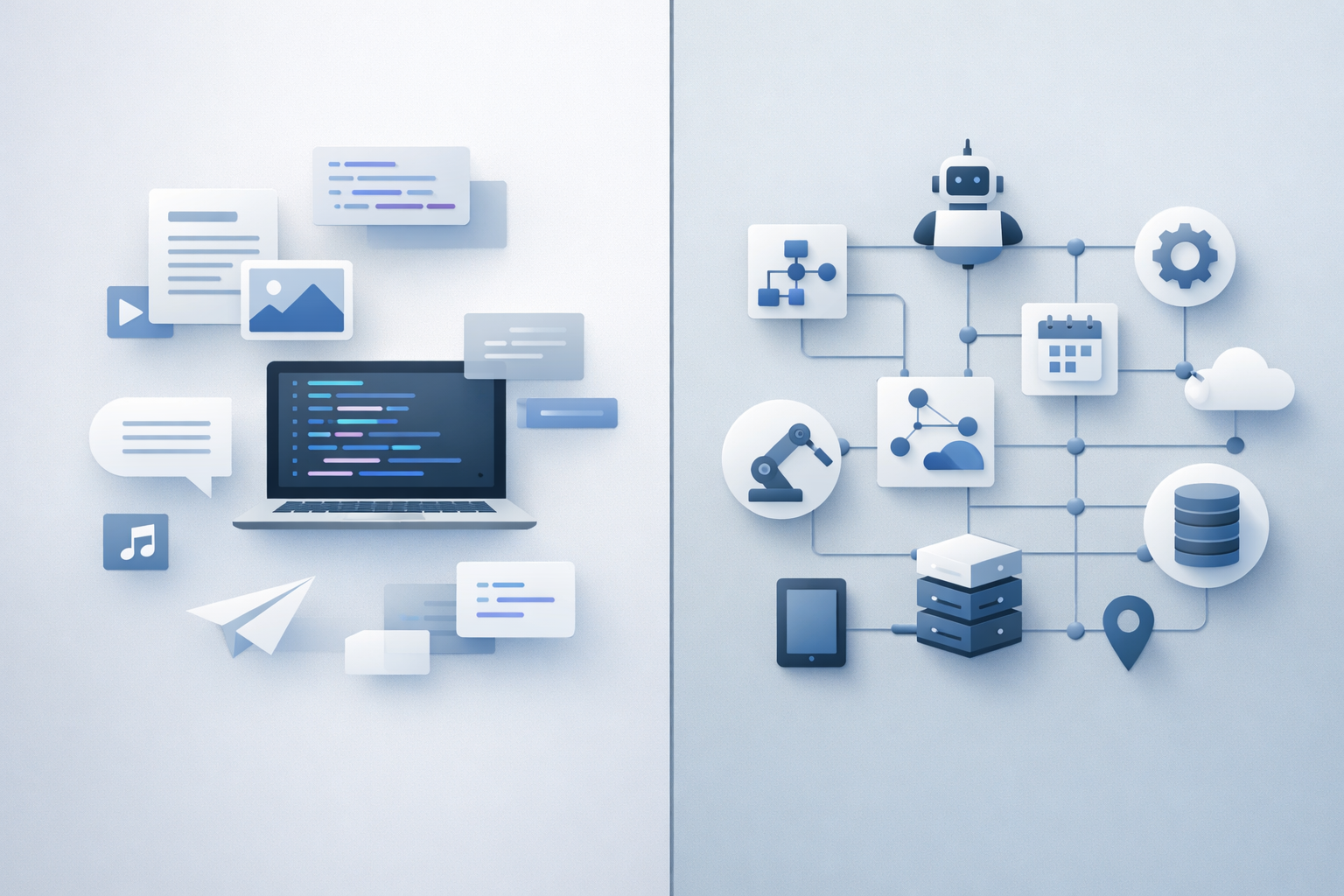
Generative AI refers to systems that produce content based on prompts and learned patterns.
Examples include:
- Text generation
- Code completion
- Image and video generation
- Summarization and translation
- Conversational assistants
Generative AI excels at:
- Producing outputs quickly
- Reducing manual effort
- Assisting humans in creative or repetitive tasks
However, generative AI is reactive. It responds to prompts but does not act independently.
What Generative AI Is Designed For
Generative AI works best when:
- A human defines the task
- The output is reviewed or consumed by a person
- The goal is speed or creativity
- Errors are acceptable within limits
Typical use cases:
- Marketing content creation
- Developer copilots
- Customer support draft responses
- Documentation and summarization
- Internal productivity tools
Generative AI improves efficiency – but it does not replace workflows.
The Limitations of Generative AI
While powerful, generative AI has clear constraints:
- No long-term goal awareness
- No autonomous decision-making
- No memory beyond context windows
- No understanding of business outcomes
- No ability to execute multi-step processes reliably
This is why many generative AI pilots never move beyond demos. They assist – but they don’t operate.
What Is Agentic AI?
Agentic AI refers to AI systems that can:
- Set or interpret goals
- Plan steps to achieve them
- Use tools and APIs
- Make decisions based on context
- Adapt based on outcomes
- Operate with limited or no human intervention
Agentic AI is not just generating content; it is executing intent. Think of Agentic AI as a system that doesn’t just answer questions, but takes action.
What Makes Agentic AI Fundamentally Different
The core difference is agency.
| Aspect | Generative AI | Agentic AI |
| Role | Assistant | Actor |
| Behavior | Reactive | Proactive |
| Decision-making | None | Contextual & goal-based |
| Workflow ownership | Human | AI-led |
| Tool usage | Limited | Core capability |
| Output | Content | Outcomes |
Agentic AI systems often include:
- Planning and reasoning layers
- Memory and state management
- Tool orchestration
- Feedback loops
- Governance and controls
From Generating Answers to Running Workflows
A simple example illustrates the difference:
Generative AI:
“Draft an email response to this customer complaint.”
Agentic AI:
“Investigate the issue, check logs, verify account status, initiate a refund if eligible, notify the customer, and update the CRM.”
The second requires:
- Context awareness
- Tool access
- Conditional decision-making
- Multi-step execution
- Accountability
This is where real business transformation begins.
Why Generative AI Alone Is Not Enough for Businesses
Generative AI improves productivity – but it does not change how businesses operate.
Agentic AI, when designed correctly, can:
- Automate end-to-end processes
- Reduce operational bottlenecks
- Enable continuous execution
- Scale decision-making
- Lower dependency on manual coordination
This is why tech-driven companies are shifting from AI features to AI systems.
Where Agentic AI Delivers Real Business Value
Agentic AI is best suited for:
- Complex workflows
- Repetitive decision-heavy processes
- Multi-system coordination
- High-volume operations
- Internal process automation
Examples include:
- Incident triage and resolution
- Financial reconciliations
- Order and fulfillment workflows
- Compliance checks
- Customer lifecycle automation
- Internal DevOps and IT operations
These are outcomes – not content.
Why Agentic AI Is Harder and Riskier to Build
Agentic AI introduces new challenges:
- Error propagation
- Unintended actions
- Cost unpredictability
- Security risks
- Governance and auditability
- Trust and explainability
Unlike generative AI, mistakes here have consequences.
This is why Agentic AI must be:
- Designed with guardrails
- Introduced incrementally
- Observed continuously
- Governed explicitly
Agentic AI without discipline creates risk – not advantage.
How Architecture Enables or Blocks Agentic AI
Agentic AI requires strong foundations:
- Modular systems
- Clear APIs
- Observable workflows
- Reliable data sources
- Infrastructure automation (IaC)
- Cost and execution controls
Monolithic, tightly coupled systems struggle to support agentic behavior.
When Organizations Should Use Each
A simple rule of thumb:
- Use Generative AI when:
- Humans remain in control
- Output quality is subjective
- Speed matters more than certainty
- Humans remain in control
- Use Agentic AI when:
- Workflows are repeatable
- Decisions follow patterns
- Scale demands automation
- Outcomes matter more than output
- Workflows are repeatable
Most mature systems use both, layered intentionally.
How Products Evolve From Generative to Agentic AI
Many successful AI products follow this progression:
- Generative AI for assistance
- Guarded automation of small tasks
- Tool-using agents with human oversight
- Semi-autonomous workflows
- Fully agentic systems with governance
Skipping steps usually leads to failure.
The Role of a Technology Partner in Agentic AI
Building agentic systems is not about choosing an LLM. It’s about:
- Workflow design
- System boundaries
- Failure handling
- Observability
- Cost controls
- Trust models
The goal is measured autonomy, not uncontrolled automation.
Generative vs Agentic AI Is Not a Competition
This is not an “either/or” decision.
Generative AI:
- Improves human productivity
Agentic AI:
- Improves system productivity
Organizations that understand this distinction build:
- Better products
- Stronger platforms
- Sustainable automation
- Defensible competitive advantages
Conclusion
Generative AI changed how people work.
Agentic AI will change how systems operate.
The companies that win will not be those that add the most AI features – but those that embed intelligence into workflows responsibly.
Understanding the difference between Generative AI and Agentic AI is no longer optional. It is foundational to building the next generation of scalable, tech-driven products.
With the right strategy, architecture, and execution discipline, AI moves from novelty to necessity, and from assistance to action.