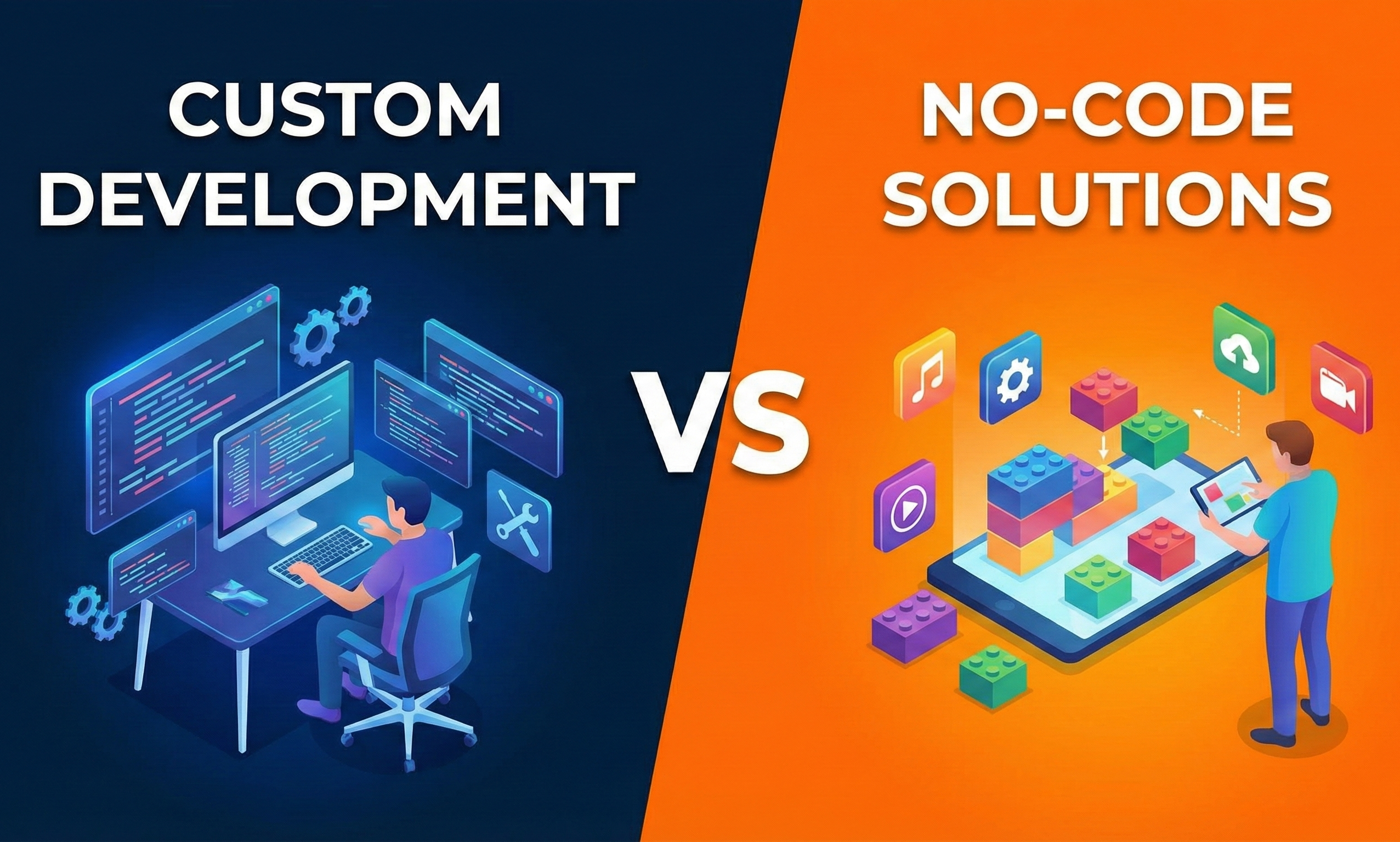
The rise of no-code and low-code platforms has changed how digital products are built. Founders can now launch websites, internal tools, and even SaaS applications without writing traditional code. At the same time, custom software development remains the gold standard for building scalable, secure, and differentiated products.
For startups and growing businesses, choosing between custom development and no-code solutions is not a purely technical decision. It directly affects speed to market, product flexibility, scalability, cost structure, and long-term control.
This guide provides a clear, unbiased comparison to help you decide what is right for your product at its current stage.
1. What Is Custom Development?
Custom development refers to building software from the ground up using programming languages, frameworks, and cloud infrastructure tailored specifically to your business requirements.
A custom-built product typically includes:
- Purpose-built frontend and backend
- Custom APIs and integrations
- Scalable architecture
- Full control over data and infrastructure
- Tailored security and compliance setup
Custom development is commonly used for SaaS platforms, fintech products, marketplaces, enterprise systems, and consumer applications that require flexibility and long-term scalability.
2. What Are No-Code Solutions?
No-code platforms allow users to build applications through visual interfaces, drag-and-drop components, and pre-configured logic – without writing code.
Popular no-code tools include:
These platforms abstract complexity, allowing non-technical users to build functional products quickly.
3. Speed to Market: No-Code Wins Early
Speed is often the biggest advantage of no-code platforms.
No-Code Advantages
- Rapid setup and deployment
- Minimal technical knowledge required
- Ideal for prototypes, internal tools, and MVPs
- Faster iteration cycles
A simple product can be launched in days or weeks instead of months.
Custom Development Reality
- Requires planning, design, development, and testing
- Longer initial timelines
- Higher upfront investment
If speed is the primary goal and complexity is low, no-code solutions offer a strong advantage in the early stages.
4. Flexibility and Product Differentiation
This is where custom development clearly stands out.
Custom Development Strengths
- Complete freedom in product design
- Ability to implement unique workflows
- Deep integrations with external systems
- Custom performance optimizations
- No platform limitations
No-Code Limitations
- Restricted by platform features
- Difficult to implement complex logic
- Limited control over UI/UX at scale
- Workarounds often replace clean solutions
If your product needs to be differentiated, complex, or unique, custom development is the safer long-term choice.
5. Scalability and Performance
Custom Development
Custom systems are designed with growth in mind:
- Horizontal and vertical scaling
- Microservices or modular architecture
- Custom caching and database optimization
- Cloud-native infrastructure
This makes custom development suitable for products expecting rapid user growth or high traffic.
No-Code Platforms
No-code tools scale reasonably well up to a point, but:
- Performance bottlenecks can emerge
- Platform limits may restrict growth
- Scaling costs can rise quickly
- Advanced optimization is often unavailable
No-code scales for small to mid-sized use cases. Custom development is better for high-growth products.
6. Cost Considerations: Short-Term vs Long-Term
No-Code Cost Profile
- Low upfront cost
- Subscription-based pricing
- Additional fees for users, workflows, or storage
- Increasing costs as usage grows
Custom Development Cost Profile
- Higher upfront investment
- Engineering and infrastructure costs
- Lower marginal cost as scale increases
- No per-user platform fees
No-code is cheaper initially. Custom development becomes more cost-effective as the product scales.
7. Security, Compliance, and Data Control
Custom Development
- Full control over data storage
- Custom security architecture
- Compliance with industry regulations (GDPR, SOC 2, PCI DSS)
- Ability to implement advanced authentication and authorization
No-Code Platforms
- Security depends on the platform provider
- Limited control over data residency
- Compliance may not meet industry standards
- Shared infrastructure increases risk in regulated industries
For fintech, healthcare, enterprise, or data-sensitive products, custom development is strongly recommended.
8. Ownership and Vendor Lock-In
Custom Development
- You own the source code
- You control hosting and deployment
- You can switch vendors or teams freely
- Long-term independence
No-Code Platforms
- Platform dependency
- Limited export options
- Migration can be complex or costly
- Risk if the platform changes pricing or policies
Custom development offers long-term ownership and flexibility. No-code involves inherent vendor dependency.
9. Maintenance and Long-Term Evolution
Custom Development
- Requires engineering resources
- Ongoing maintenance and updates
- Full control over roadmap and upgrades
No-Code Platforms
- Platform handles updates
- Less maintenance effort
- Limited ability to influence platform changes
Key Trade-off:
No-code reduces operational effort early. Custom development provides long-term strategic control.
10. When No-Code Is the Right Choice
No-code is ideal if:
- You are validating an idea or market
- You need a prototype or an internal tool
- Your workflows are simple
- You have limited technical resources
- Speed is more important than flexibility
Examples:
- Landing pages
- Internal dashboards
- Simple MVPs
- Automation workflows
11. When Custom Development Is the Right Choice
Custom development is ideal if:
- You are building a core product or platform
- You expect significant growth
- Your product requires complex logic
- You need high performance and security
- You want full ownership and flexibility
Examples:
- SaaS platforms
- Marketplaces
- FinTech and InsurTech products
- Consumer applications
- Enterprise systems
12. A Hybrid Approach: Best of Both Worlds
Many successful startups adopt a hybrid strategy:
- No-code for early prototypes or internal tools
- Custom development for core product functionality
- Gradual migration as complexity grows
This approach balances speed, cost, and scalability.
Conclusion
There is no universal answer to the custom development vs no-code debate. The right choice depends on your product’s stage, complexity, budget, and long-term vision.
- No-code is excellent for speed, experimentation, and early validation
- Custom development is essential for scalability, differentiation, and long-term success
The key is not choosing one forever, but choosing the right approach at the right stage of your product journey.