
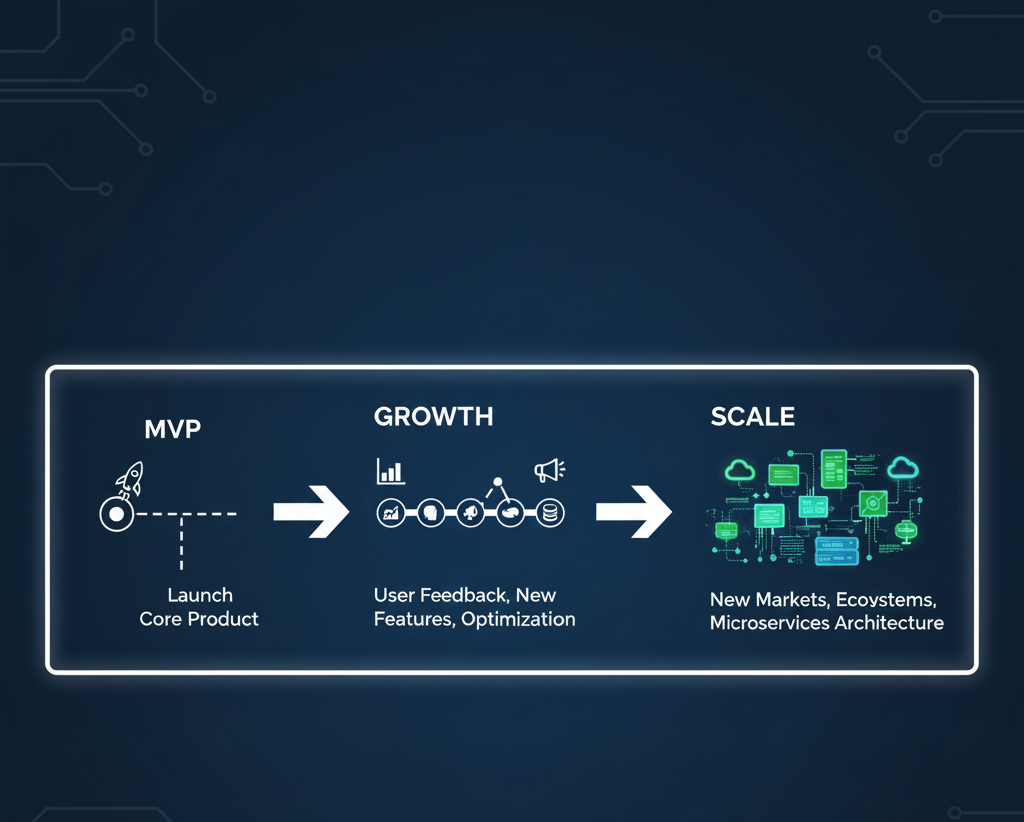
A product roadmap that works during the MVP stage often breaks down once a startup begins to scale. This is not because the roadmap was wrong – but because roadmaps must evolve as the product, users, and organization evolve.
Many startups struggle during this transition. They either:
- keep using an MVP-style roadmap for too long, or
- swing to rigid, feature-heavy roadmaps too early
Both approaches create friction, misalignment, and wasted effort.
This blog explains how product roadmaps should evolve from MVP to scale, outlines the changes that occur at each stage, and provides guidance on how founders can maintain effective roadmaps as complexity increases.
The Purpose of a Roadmap Changes as You Grow
Before diving into stages, it’s important to understand one core idea:
A roadmap’s purpose is not to predict the future.
Its purpose is to align teams around what matters now.
During MVP
- The roadmap exists to validate assumptions
- Learning is more important than predictability
- Speed and focus matter most
During Scale
- The roadmap exists to coordinate execution
- Reliability, sequencing, and trade-offs matter more
- Multiple teams must move in alignment
A roadmap that doesn’t change its role will eventually stop working.
MVP Stage: Outcome-Driven and Hypothesis-Based Roadmaps
What the MVP Roadmap Looks Like
At the MVP stage, your roadmap should be:
- Short-term
- Flexible
- Outcome-focused
- Hypothesis-driven
Instead of listing features, it should answer:
- What assumptions are we testing?
- What user problem are we validating?
- What learning do we need next?
Good MVP Roadmap Themes
- User onboarding and activation
- Core workflow validation
- Data collection for learning
- Basic reliability and usability
What to Avoid at This Stage
- Long-term timelines
- Feature parity with competitors
- Scalability initiatives without demand
- Heavy infrastructure work
Post-MVP: From Hypotheses to Patterns
Once users start engaging with the MVP, the roadmap must shift from testing assumptions to recognizing patterns.
What Changes
- You now have real usage data
- Some assumptions are validated, others are not
- Users begin asking for improvements, not just core functionality
How the Roadmap Evolves
- From hypotheses → insights
- From “Will this work?” → “How do we improve it?”
- From single workflows → connected experiences
Typical Post-MVP Roadmap Themes
- UX refinement and friction reduction
- Feature depth for high-usage areas
- Stability and bug reduction
- Basic analytics and reporting
This is where many startups go wrong by expanding scope too fast instead of deepening value where traction exists.
Early Scale: Introducing Prioritization and Trade-Offs
As traction grows, roadmaps must handle constraints:
- Limited engineering capacity
- Increasing technical debt
- Conflicting stakeholder demands
- Rising customer expectations
What a Scaling Roadmap Must Do
- Balance new features with platform stability
- Make trade-offs explicit
- Protect team focus
- Align product and engineering priorities
Key Shift
The roadmap moves from:
“What should we try next?”
to
“What should we not do right now?”
Rezolut often helps founders introduce impact vs effort prioritization at this stage to avoid roadmap overload.
Scaling Stage: From Feature Lists to Strategic Themes
At scale, feature-based roadmaps become liabilities.
Why Feature-Based Roadmaps Fail
- They lock teams into premature commitments
- They don’t adapt well to change
- They encourage output over outcomes
What Works Better
Theme-based roadmaps, such as:
- Growth and activation
- Retention and engagement
- Reliability and performance
- Monetization and pricing
- Platform and scalability
- Security and compliance
Each theme contains initiatives that may evolve, without committing to exact features months in advance.
Aligning Roadmaps with Architecture and System Design
As the product scales, roadmap decisions increasingly affect architecture.
Examples:
- Adding enterprise features may require permission models
- Growth features may demand performance optimization
- New integrations may impact system boundaries
What Changes in the Roadmap
- Architecture work becomes explicit (not hidden)
- Refactoring and technical investments are planned
- Observability and reliability appear as roadmap items
Rezolut strongly advocates making system design and technical health visible in the roadmap rather than treating them as side work.
Roadmaps Must Reflect Team Structure
A roadmap that worked for one small team will fail with multiple teams.
Signs the Roadmap Is Out of Sync
- Teams block each other
- Dependencies are unclear
- Delivery dates slip repeatedly
- Ownership is ambiguous
How Roadmaps Evolve
- From single roadmap → multi-stream roadmap
- Clear ownership per theme or domain
- Fewer shared dependencies
- More parallel execution
This evolution often coincides with shifts from monoliths to modular monoliths or selective microservices.
Introducing Predictability Without Killing Flexibility
At scale, stakeholders expect more predictability:
- Sales needs timelines
- Customers expect commitments
- Leadership needs planning confidence
But too much rigidity kills adaptability.
Best Practice
- Use time horizons instead of exact dates
- Now (committed)
- Next (planned)
- Later (exploratory)
- Now (committed)
- Separate:
- Committed delivery from
- Directional intent
- Committed delivery from
This maintains high trust without locking the team into poor decisions.
Metrics Become Central at Scale
At the MVP stage, metrics are learning signals.
At scale, metrics drive roadmap decisions.
Scaled Roadmaps Are Anchored To:
- Retention and churn
- Activation funnels
- Revenue impact
- Reliability metrics (uptime, latency)
- Support and operational load
Roadmaps that don’t tie initiatives to metrics become opinion-driven and political.
Common Roadmap Mistakes During the MVP-to-Scale Transition
Founders should actively avoid:
- Carrying MVP roadmaps too far into growth
- Turning roadmaps into feature wishlists
- Hiding technical work to “look productive.”
- Overcommitting to long-term plans
- Ignoring architecture and reliability needs
- Letting roadmaps be dictated by the loudest voice
Most roadmap failures during scaling are governance failures, not planning failures.
How Rezolut Helps Products Evolve Their Roadmaps
Rezolut Infotech works with startups across the entire lifecycle – from MVP to scale – to ensure roadmaps remain effective.
Rezolut’s Roadmap Evolution Approach
- MVP outcome mapping
- Post-MVP insight-driven prioritization
- Theme-based roadmap design
- Architecture-aware planning
- Capacity and dependency mapping
- Continuous roadmap refinement
The focus is not on building more – but on building what matters next.
A Simple Roadmap Evolution Summary
| Stage | Roadmap Focus |
| MVP | Learning, validation, hypotheses |
| Post-MVP | Pattern recognition, UX depth |
| Early Scale | Trade-offs, prioritization |
| Scale | Strategy, coordination, reliability |
Roadmaps should grow in structure and discipline, not in rigidity.
Conclusion
A roadmap that works for an MVP will not work forever – and that’s expected.
As products scale, roadmaps must evolve:
- from hypotheses to insights
- from features to themes
- from speed to sustainability
- from individual execution to team coordination
Founders who treat roadmaps as living systems – rather than static plans – navigate growth with far less friction.
With the right roadmap evolution and the right product partner, startups can scale without losing focus, velocity, or clarity.
At Rezolut Infotech, roadmaps are designed to evolve alongside the product – supporting growth, not constraining it.