Building a successful digital product is not just about coding fast – it’s about validating ideas, understanding users, and launching with the right level of depth at the right time. Many founders rush into development without clarity on what stage they should build first, leading to wasted time, budget overruns, and products that don’t achieve real market fit.
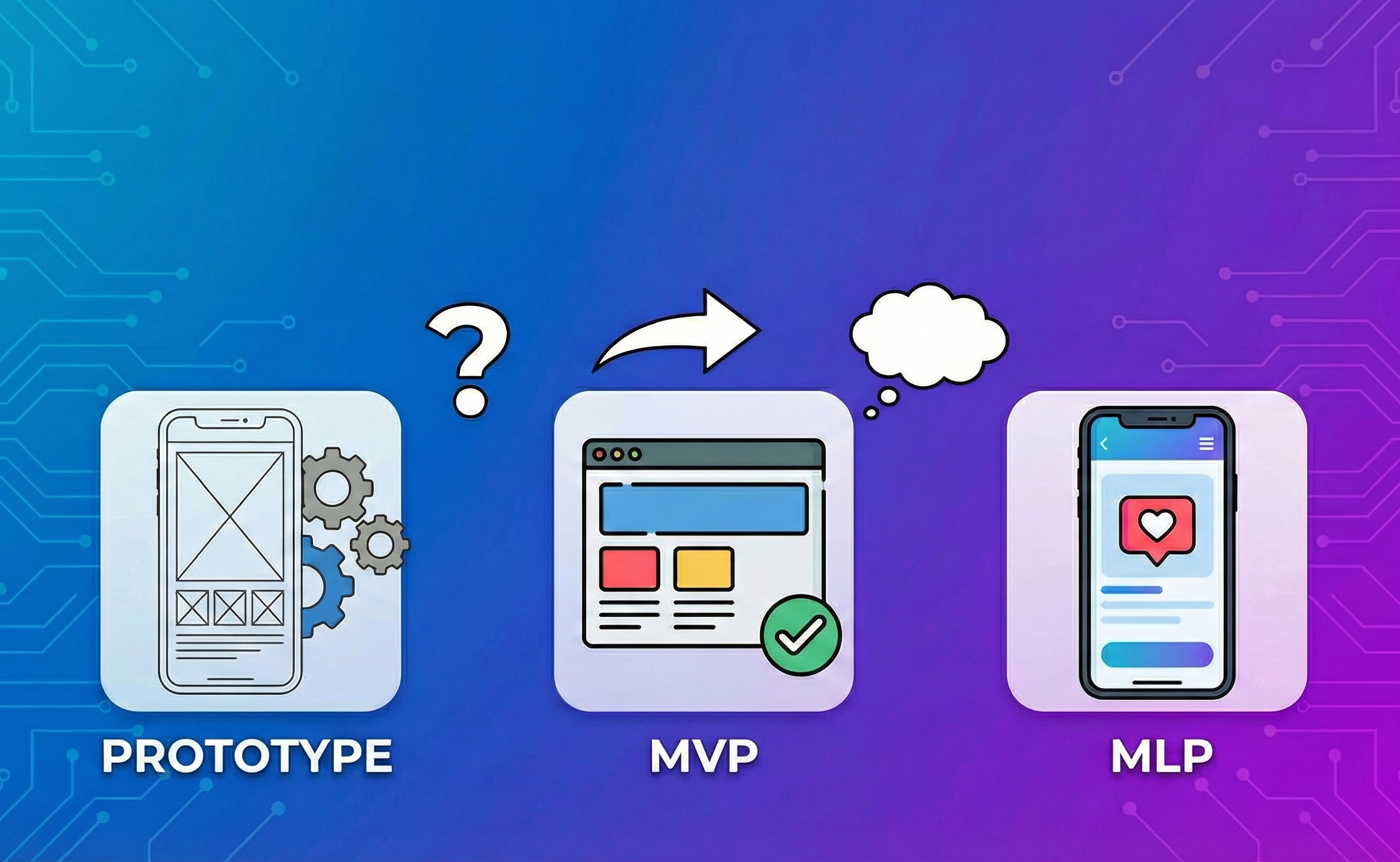
Three stages are often confused: Prototype, MVP, and MLP. While the terms are often used interchangeably, they serve distinct purposes in the product journey.
This guide breaks down each one, how they work, when to use them, and which is best for your current product stage.
1. What Is a Prototype?
A prototype is the earliest representation of a product concept. It is used to validate assumptions quickly and at a low cost – before writing production-grade code.
A prototype can be:
- A wireframe
- A clickable mockup
- A design-based simulation
- A visual representation of the user journey
Prototypes help founders and teams visualize the product and gather early feedback.
Why Prototypes Matter
- Validate ideas early without spending on development
- Align stakeholders on the product direction
- Test flows and usability before committing resources
- Identify gaps in user journeys
- Speed up decision-making for founders and investors
Prototypes prevent costly mistakes by surfacing issues early.
Types of Prototypes
1. Low-Fidelity Prototype
Rough sketches or basic wireframes – fast, simple, and conceptual.
2. High-Fidelity Prototype
Realistic designs with clickable interactions – look close to the final product.
3. Functional Prototype
Includes limited backend logic or simulation of real workflows.
When Should You Build a Prototype?
A prototype is ideal if:
- You are validating an idea
- You want to pitch to investors
- You need to test flows with real users
- You are unsure about features or UX
- You want a visual blueprint before code starts
A prototype is NOT meant for launch – it’s meant for learning.
2. What Is an MVP (Minimum Viable Product)?
An MVP is a functional version of your product with only the essential features required to solve the core problem for users.
It is the bridge between idea validation and real-world usage.
An MVP must:
- Be usable
- Solve the primary problem
- Allow users to complete key actions
- Provide feedback to guide future decisions
An MVP is not a “cheap version” of your product – it is the smartest version built fast.
Why MVPs Are Critical
- Validates product-market fit with real users
- Reduces development cost by focusing only on essentials
- Shortens time-to-market
- Gathers user feedback early
- Prevents building unnecessary features
- Helps refine business models
Startups often struggle because they build too much, too soon. MVPs solve this problem.
What Should an MVP Contain?
- Core value proposition
- Key workflows
- Simple but usable UI
- Basic authentication
- Foundational backend
- Essential analytics
If the feature doesn’t support the core value, don’t include it in the MVP.
When Should You Build an MVP?
Build an MVP if:
- Your idea is validated
- You want users to test your product
- Your business model needs real-world testing
- You need early traction before fundraising
- You want to avoid over-building
MVPs are perfect for early-stage startups ready to launch into the market.
3. What Is an MLP (Minimum Lovable Product)?
An MLP goes beyond functionality – it focuses on delight.
It doesn’t just solve the problem; it gives users a reason to love the experience.
An MLP elevates an MVP by enhancing:
- Design quality
- User experience
- Personalization
- Emotional appeal
- User satisfaction
The goal?
Turn early adopters into loyal advocates.
Why MLPs Matter
Users don’t just want working products – they want enjoyable products.
MLPs help:
- Increase user retention
- Improve brand perception
- Strengthen long-term loyalty
- Drive organic growth through word of mouth
In a crowded market, functionality isn’t enough – experience wins.
Characteristics of an MLP
An MLP includes:
- Polished UI
- Smooth interactions
- Thoughtful onboarding
- Personalization features
- Clear emotional value
- High reliability
Think of the difference between simply functional vs. truly delightful.
When Should You Build an MLP?
An MLP is right for you if:
- Your MVP has traction
- Users are engaging with the product
- You want to differentiate from competitors
- You’re preparing for scale or fundraising
- You want to convert early adopters into champions
MLPs are ideal for growth-stage startups looking to strengthen market fit.
Prototype vs MVP vs MLP: Understanding the Differences
Here’s a quick summary of how each stage fits into the product journey:
| Stage | Purpose | Output | When to Use |
| Prototype | Validate ideas | Design mockups or wireframes | Before development |
| MVP | Test the core product with real users | Basic functional product | Early launch |
| MLP | Deliver joy, retention, and polish | Refined, lovable version | Post-MVP traction |
Each stage builds on the previous one.
Which One Does Your Startup Need Right Now?
Choose a Prototype if:
You’re still exploring ideas, building user flows, or pitching.
Choose an MVP if:
You’re ready to launch but want to avoid unnecessary complexity.
Choose an MLP if:
You want to improve retention, brand perception, and user satisfaction.
Choosing the wrong stage can waste time and money.
For example:
- Building an MVP without prototyping leads to poor UX and rework
- Building an MLP too early wastes resources before market validation
- Skipping MVP and building a fully-featured product is a common failure point
The right choice depends entirely on your current stage.
How Rezolut Infotech Helps Startups Choose the Right Path
At Rezolut, we guide founders across every stage of the product lifecycle:
1. Prototyping
We create:
- Wireframes
- User flows
- High-fidelity design prototypes
- Product architecture recommendations
This gives founders a clear visual roadmap.
2. MVP Development (4.5-Month Framework)
Our signature delivery model helps startups build functional products fast:
- Modular architecture
- Clean codebase
- Essential features only
- High performance
- Clear analytics
This reduces risk and accelerates learning.
3. MLP Development
Once your MVP works, we elevate it into something customers love:
- UX enhancements
- Visual refinement
- Product polish
- Adaptive personalization
- Improved stability
This approach turns early traction into sustainable growth.
Conclusion
Prototype, MVP, and MLP are not competing approaches – they are a sequence. Each plays a key role in moving your product from idea to market to love.
- Prototype → validate quickly
- MVP → launch smartly
- MLP → scale with delight
Choosing the right stage at the right time helps founders save money, test effectively, iterate faster, and deliver products that users actually want.
In today’s competitive environment, building fast is important – but building the right version at the right stage is what separates successful startups from failed ones.