Software-as-a-Service (SaaS) has gone through multiple waves of evolution. What started as simple cloud-hosted alternatives to on-premise software has matured into sophisticated platforms that power critical business operations across industries.
Today, SaaS is entering its next major phase.
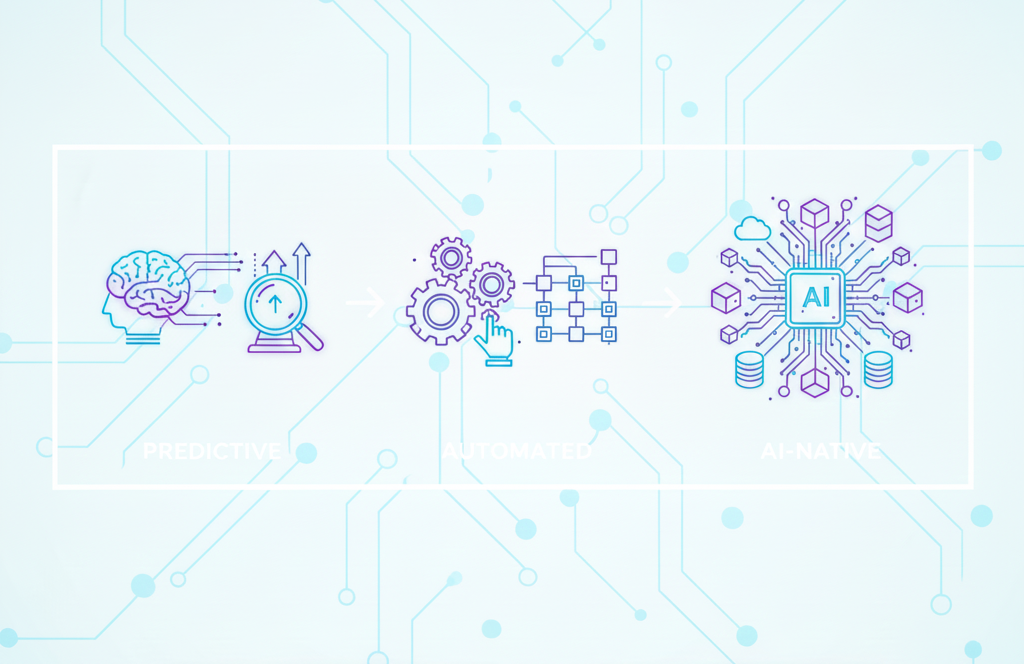
The future of SaaS platforms is not just cloud-based or subscription-driven. It is predictive, automated, and AI-native by design. Products that fail to evolve in this direction risk becoming slower, less relevant, and harder to scale in an increasingly competitive market.
From Reactive SaaS to Predictive Platforms
Traditional SaaS platforms are largely reactive:
- Users input data
- Systems process requests
- Dashboards display historical information
- Actions are taken manually
While this model works, it places the cognitive and operational burden on users.
The Shift to Predictive SaaS
Future-ready SaaS platforms move from:
“Here’s what happened.”
to
“Here’s what will likely happen next – and what you should do about it.”
Predictive Capabilities Include:
- Forecasting user behavior
- Predicting churn or drop-off
- Anticipating system bottlenecks
- Identifying revenue or risk patterns
- Recommending proactive actions
This shift transforms SaaS from a reporting tool into a decision-support system.
Automation as a Core Product Capability
Early SaaS products focused on digitization. Modern SaaS focuses on automation.
But there’s an important distinction:
- Bad automation removes control
- Good automation removes friction
The Future of Automation in SaaS
Automation will increasingly:
- Trigger actions without manual input
- Adapt workflows based on context
- Handle exceptions intelligently
- Scale operations without proportional hiring
Examples:
- Automated lead scoring and follow-ups
- Smart ticket routing and resolution
- Workflow orchestration across tools
- Automated compliance checks
- Infrastructure self-healing actions
Automation becomes most powerful when it is:
- Context-aware
- Transparent
- Override-friendly
What “AI-Native SaaS” Really Means
Many platforms claim to “add AI.” Few are truly AI-native.
AI-Enabled vs AI-Native
- AI-enabled SaaS: AI features are bolted on
- AI-native SaaS: AI is embedded into the core workflows, architecture, and decision logic
AI-native platforms are designed assuming:
- AI will assist users continuously
- Natural language will be a primary interface
- Systems will learn from usage patterns
- Intelligence will evolve over time
This is not about chatbots everywhere – it’s about intelligence woven into the product experience.
Copilots Become the Default Interface
One of the most visible shifts in SaaS is the rise of AI copilots.
Why Copilots Are Winning
Users don’t want:
- Complex dashboards
- Endless configuration screens
- Dozens of filters
They want:
- Clear answers
- Smart suggestions
- Help at the moment of need
Copilots Enable:
- Natural language interaction
- Contextual recommendations
- Task assistance inside workflows
- Faster onboarding and learning
Instead of replacing users, copilots augment decision-making – a pattern that consistently delivers higher adoption and trust.
Rezolut builds copilots that are:
- Context-aware
- Grounded in real data (often using RAG)
- Explainable and measurable
SaaS Platforms Become Outcome-Driven, Not Feature-Driven
Traditional SaaS competes on features.
Future SaaS competes on outcomes.
What Changes
Users care less about:
- Number of features
- Technical sophistication
They care more about:
- Time saved
- Errors reduced
- Revenue increased
- Risk avoided
AI-native SaaS platforms are increasingly:
- Recommend next best actions
- Highlight risks before they become problems
- Guide users toward better outcomes
This fundamentally changes product roadmaps – from feature lists to impact-driven initiatives.
Data as a Living Asset, Not a Static Resource
In AI-native SaaS, data is not just stored – it is continuously interpreted.
Key Shifts:
- From dashboards → insights
- From raw metrics → explanations
- From manual analysis → AI-assisted summaries
LLMs and predictive models act as a translation layer between complex data and human understanding.
This makes SaaS platforms more accessible to:
- Non-technical users
- Business leaders
- Cross-functional teams
Rezolut often integrates LLM-powered insight layers on top of existing analytics rather than replacing them.
Architecture Must Evolve to Support AI-Native SaaS
AI-native SaaS requires architectural changes.
Key Architectural Characteristics:
- Modular systems (often modular monolith → selective microservices)
- Event-driven workflows
- Strong observability
- Data pipelines designed for learning
- Secure data access layers
- Cost-aware AI usage
Without this foundation, AI features become fragile, expensive, or unreliable.
Rezolut treats AI as infrastructure, not just an API call – ensuring systems scale predictively, not chaotically.
Trust, Explainability, and Governance Become Differentiators
As AI takes on more responsibility, trust becomes a product feature.
Future SaaS platforms will be judged on:
- Accuracy
- Explainability
- Auditability
- Data governance
- Failure handling
This is especially true in:
- FinTech
- InsurTech
- Healthcare
- Enterprise SaaS
Techniques like retrieval-augmented generation (RAG), transparent prompts, and traceable outputs are no longer optional – they are expected.
Internal AI Delivers as Much Value as Customer-Facing AI
Many SaaS companies focus only on customer-facing AI, but the future also lies in AI-powered internal operations.
High-Impact Internal AI Use Cases:
- Support ticket summarization
- Incident analysis for engineering
- QA and test generation
- Product feedback clustering
- Sales call insights
These capabilities:
- Reduce operational load
- Improve delivery speed
- Scale teams without adding headcount
The Competitive Gap Will Widen Quickly
The future of SaaS is not evenly distributed.
Companies that:
- Invest early in AI-native foundations
- Build predictive and automated workflows
- Design for trust and explainability
will move faster and compound advantages.
Those that:
- Treat AI as a marketing feature
- Bolt it on without system changes
- Ignore data quality and architecture
will struggle to keep up.
This gap will widen over the next 3 – 5 years.
How Rezolut Helps SaaS Platforms Become Future-Ready
Rezolut Infotech works with SaaS founders and product teams to build platforms designed for this next phase.
Rezolut’s SaaS & AI Approach:
- Product discovery focused on outcomes
- AI use-case prioritization (value over hype)
- Predictive and automation-first design
- AI-native architecture planning
- RAG-based trustworthy AI systems
- Gradual rollout with clear ROI metrics
The goal is not to “add AI,” but to build SaaS platforms that think, adapt, and scale intelligently.
Conclusion
The future of SaaS platforms is already taking shape.
They will be:
- Predictive – anticipating problems and opportunities
- Automated – reducing manual effort and operational drag
- AI-native – designed around intelligence, not retrofitted with it
For founders and product leaders, the question is no longer if SaaS will evolve this way – but how soon your product will.
Those who invest early in the right architecture, workflows, and AI strategy will not just survive the next wave – they will define it.
With the right vision and the right technology partner, SaaS platforms can evolve from tools users operate into systems that actively help users succeed.