Many teams believe that launching an MVP is the end of early product development. In reality, it is only the beginning. This misunderstanding often leads to stalled growth, weak adoption, and products that technically work but fail to gain momentum.
This is where the distinction between MVP (Minimum Viable Product) and MLP (Minimum Lovable Product) becomes critical.
Both serve different purposes. Both are important. And choosing the wrong one at the wrong time can cost startups and businesses valuable time, trust, and market opportunity.
What Is an MVP (Minimum Viable Product)?
An MVP is the simplest version of a product that can:
- Solve a core user problem
- Be used by real users
- Generate meaningful feedback
The primary goal of an MVP is validation, not growth.
What an MVP Is Designed to Validate
- Is the problem real and worth solving?
- Do users care enough to use the product?
- Does the core solution work?
- Are our assumptions correct?
An MVP is intentionally limited. It prioritizes:
- Learning over Polish
- Speed over completeness
- Clarity over delight
If an MVP feels rough around the edges, that is often acceptable – as long as it delivers core value.
What an MVP Is Not
An MVP is not:
- A scaled product
- A marketing-ready release
- A feature-complete solution
- A long-term user experience benchmark
Treating an MVP as a finished product is one of the most common mistakes teams make.
What Is an MLP (Minimum Lovable Product)?
An MLP builds on top of a validated MVP.
While an MVP asks, “Does this work?”
An MLP asks, “Do users enjoy using this?”
The goal of an MLP is adoption, retention, and trust.
What an MLP Focuses On
- User experience and usability
- Emotional connection and confidence
- Reliability and performance
- Reducing friction in key workflows
- Making the product feel intentional and thoughtful
An MLP is where users start recommending the product, not just tolerating it.
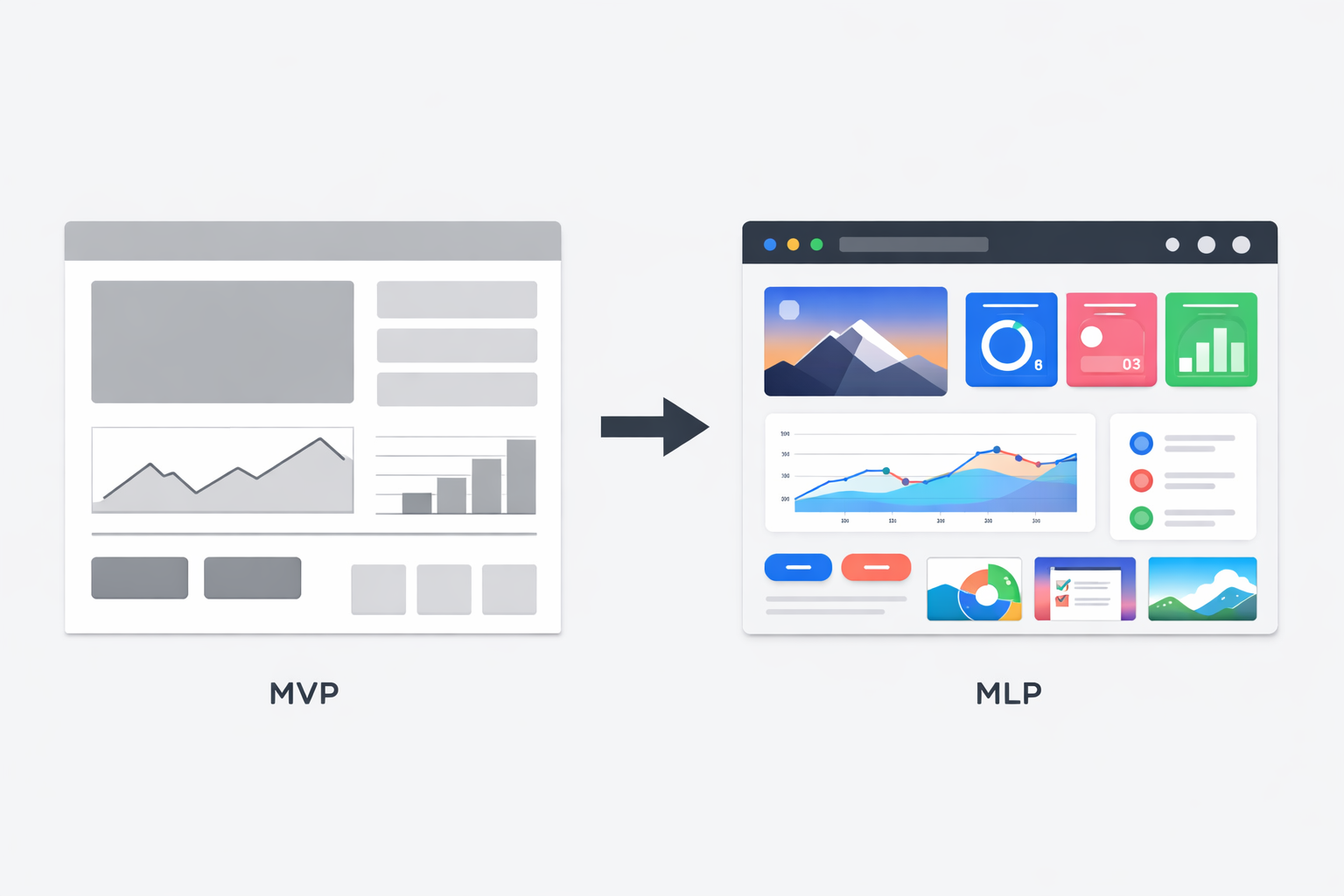
Key Differences Between MVP and MLP
| Aspect | MVP | MLP |
| Primary goal | Validation | Adoption & retention |
| Focus | Core functionality | Experience & trust |
| UX quality | Acceptable | Thoughtful and polished |
| Feature depth | Minimal | Focused but refined |
| Target users | Early adopters | Broader early market |
| Success metric | Learning | Engagement & loyalty |
Both are essential – but they are not interchangeable.
When You Should Build an MVP
You should build an MVP when:
- The problem is not fully validated
- User behavior is uncertain
- The business model is unproven
- You need fast feedback
- Resources are limited
- Speed matters more than polish
At this stage, investing heavily in experience or refinement is premature. You are still learning what matters.
When You Should Move to an MLP
You should move toward an MLP when:
- The core problem is validated
- Users are consistently engaging
- Feedback patterns are clear
- Retention starts to matter
- You want users to choose you over alternatives
This is often where products either:
- Break through and grow
- Or stagnate due to a lack of emotional connection
An MLP bridges the gap between working software and a product people trust.
Why Many Products Get Stuck Between MVP and MLP
A common failure mode is the “forever MVP.”
Symptoms include:
- Users say the product is “useful but rough.”
- Adoption stalls despite validation
- Referrals are weak
- Competitors with better UX win users
- Teams keep adding features without improving the experience
This happens when teams:
- Continue validating instead of refining
- Underestimate UX and reliability
- Treat delight as optional
- Delay investment in quality and trust
An MLP is not about adding more features – it’s about making the right features lovable.
MLP Is Not About Perfection
It’s important to clarify what an MLP is not.
An MLP is not:
- Pixel-perfect everywhere
- Over-designed
- Feature-heavy
- Enterprise-grade in all aspects
An MLP focuses on:
- The most important workflows
- The most valuable users
- The moments that define perception
Lovable does not mean luxurious – it means considerate and reliable.
How Architecture and Engineering Change From MVP to MLP
The transition from MVP to MLP often requires technical evolution.
Typical changes include:
- Cleaner internal structure (often modularization)
- Improved performance and stability
- Better error handling and observability
- UX-driven backend improvements
- Refactoring shortcuts taken during MVP
This does not mean a rewrite – if the MVP was built with discipline.
Rezolut designs MVPs with a clear path to MLP, avoiding architectural decisions that block refinement later.
MVP vs MLP From a Business Perspective
For CXOs and business leaders:
- MVP reduces idea risk
- MLP reduces market risk
Investors and customers rarely care that something is an MVP. They care whether:
- The product feels trustworthy
- The experience is intuitive
- The team understands user needs
MLPs are often where:
- Sales become easier
- Retention improves
- Brand perception forms
- Word-of-mouth begins
How Rezolut Helps Teams Navigate MVP to MLP
At Rezolut Infotech, the MVP-MLP transition is treated as a planned evolution, not an afterthought.
Rezolut supports teams by:
- Defining clear validation milestones for MVP
- Identifying the right moment to shift focus
- Prioritizing experience improvements with business impact
- Evolving architecture without disruption
- Aligning product, design, and engineering decisions
- Preventing feature sprawl during refinement
This ensures teams don’t over-invest too early – or under-invest too late.
A Simple Rule of Thumb
- If you are still asking, “Should this exist?” → build an MVP
- If you are asking, “Why aren’t users sticking around?” → build an MLP
Trying to skip directly to an MLP without validation increases risk.
Staying at MVP too long limits growth.
Conclusion
MVP and MLP are not competing concepts – they are sequential stages of a healthy product journey.
- MVP helps you learn whether you should build the product
- MLP helps users feel confident choosing it
Products that succeed understand when to switch from validation mode to experience mode.
With the right strategy, architecture, and technology partner, teams can transition smoothly from MVP to MLP, turning early traction into lasting growth rather than stalled potential.