Startups live in a world of constraints.
- Limited capital.
- Small engineering teams.
- Aggressive timelines.
- High uncertainty.
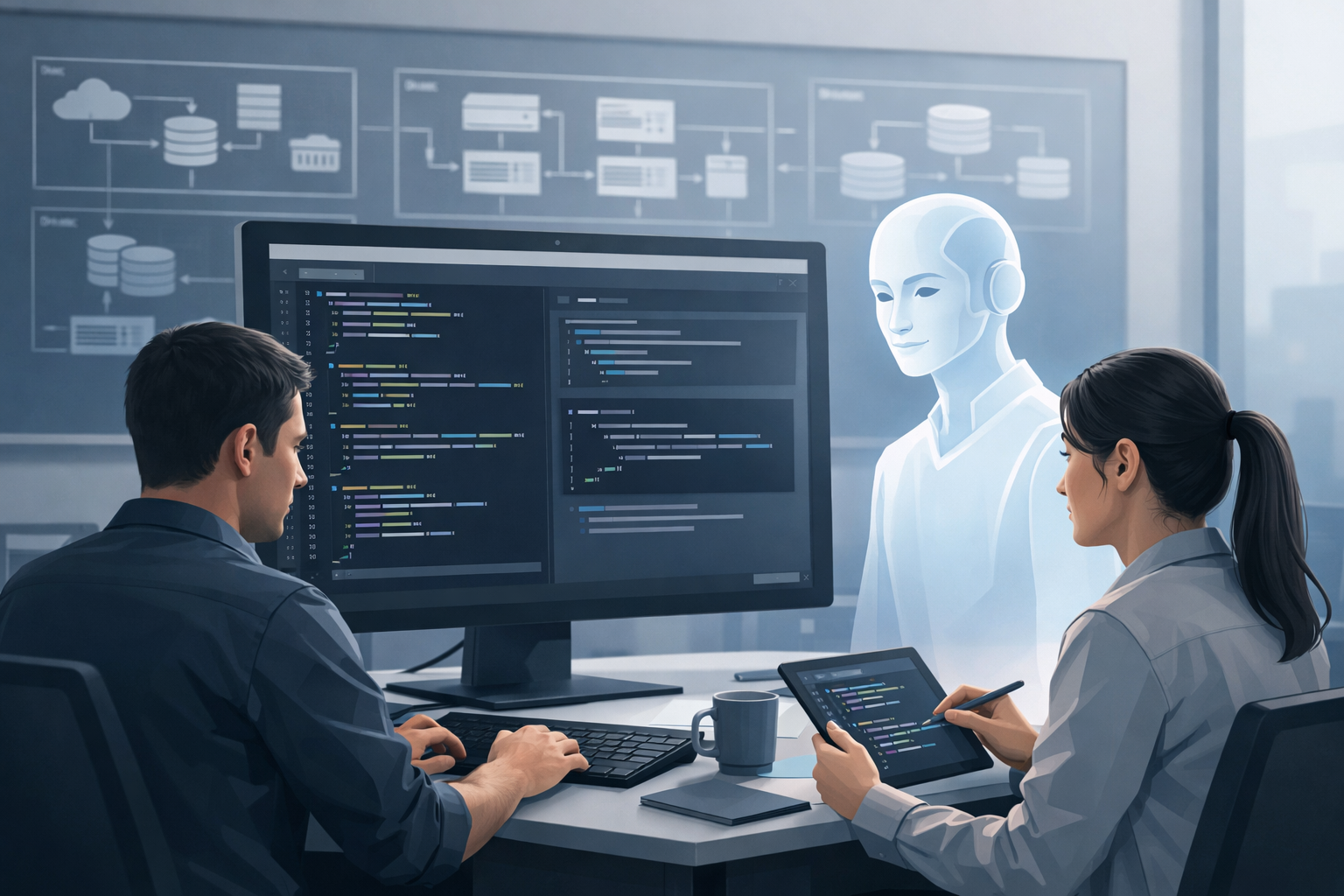
One of the strongest leverage tools available to startups is AI coding assistants.
Tools like GitHub Copilot, Claude, GPT-4, and Cursor are no longer experimental. They are becoming core components of modern engineering workflows.
1. Speed Is a Competitive Advantage
Startups compete against time.
AI coding assistants dramatically reduce:
- Boilerplate writing
- API scaffolding
- CRUD operations
- Unit test generation
- Documentation drafting
Instead of spending hours writing repetitive logic, engineers can focus on:
- Core product differentiation
- Architecture decisions
- Performance optimization
- User experience
Speed in the early stages is survival.
2. Small Teams Can Produce Big-Team Output
Most startups begin with:
- 2–5 engineers
- One product manager
- Limited DevOps support
AI coding assistants increase effective output per developer.
They help teams:
- Explore multiple solutions quickly
- Prototype features faster
- Refactor code safely
- Understand unfamiliar libraries
This doesn’t replace engineers – it amplifies them.
3. Faster MVP Development
AI assistants are particularly powerful during the MVP stage.
They help with:
- Rapid backend generation
- Database schema suggestions
- API integration examples
- Auth flow scaffolding
- Frontend component generation
For startups validating ideas, faster MVP cycles mean:
- Earlier feedback
- Faster pivots
- Reduced burn rate
4. Better Code Documentation
One overlooked advantage of AI coding assistants is documentation.
Startups often neglect:
- Code comments
- README files
- Architecture summaries
- API documentation
AI tools can automatically:
- Explain legacy functions
- Generate inline documentation
- Create onboarding guides
This improves maintainability as teams grow.
5. Improved Debugging and Refactoring
AI assistants are strong at:
- Explaining stack traces
- Identifying logic errors
- Suggesting cleaner implementations
- Highlighting potential performance bottlenecks
For early-stage teams without senior engineering depth, this reduces costly mistakes.
6. Learning Accelerator for Junior Developers
Startups often hire:
- Junior engineers
- Career switchers
- Generalists
AI coding assistants act as:
- Real-time mentors
- Pattern advisors
- Architecture explainers
This accelerates team maturity significantly.
7. Reduced Context Switching
Modern engineering requires:
- Switching between frameworks
- Managing multiple APIs
- Writing infrastructure configs
- Handling DevOps tasks
AI tools help engineers move across domains faster without losing productivity.
Instead of searching documentation repeatedly, developers can:
- Ask for examples
- Generate configurations
- Convert between languages
Time saved compounds.
8. Supports AI-Native Product Development
Many startups in 2026 are building AI-native products.
AI coding assistants help with:
- RAG implementation
- Multi-agent workflow logic
- Prompt engineering
- Model integration
- Embedding pipelines
They shorten the learning curve in complex AI system design.
9. Cost Efficiency Compared to Hiring
Hiring senior engineers is expensive.
While AI assistants do not replace expertise, they:
- Reduce the need for large engineering teams
- Lower prototyping costs
- Decrease time-to-market
- Improve engineering efficiency
For capital-constrained startups, productivity tools matter.
10. Competitive Expectation
AI-assisted coding is becoming standard practice.
Startups that ignore it risk:
- Slower delivery cycles
- Higher development costs
- Reduced experimentation speed
In competitive markets, efficiency gaps widen quickly.
Important: AI Coding Assistants Are Not a Replacement for Engineering Discipline
Startups must avoid common mistakes:
- Blindly trusting generated code
- Skipping code reviews
- Ignoring security implications
- Embedding secrets in prompts
- Letting AI define architecture
Best practices include:
- Always review AI-generated code
- Use CI/CD validation
- Implement logging
- Track AI-generated changes
- Maintain architectural ownership
AI should accelerate engineering – not control it.
How Startups Should Adopt AI Coding Assistants Strategically
Early Stage
- Use for scaffolding and prototyping
- Focus on speed
Growth Stage
- Integrate into structured workflows
- Establish review processes
Scaling Stage
- Combine with platform engineering
- Track productivity metrics
- Implement AI governance
The Real Advantage: Compounded Productivity
The biggest benefit is not a single feature.
It’s the compound effect of:
- Faster iteration
- Cleaner code
- Better documentation
- Fewer blockers
- More experimentation
Over 12–18 months, this dramatically impacts product velocity.
Final Thoughts
Startups succeed through leverage.
AI coding assistants provide:
- Speed
- Efficiency
- Knowledge access
- Reduced cognitive load
- Faster MVP cycles
The question is no longer whether startups should use AI coding assistants.
The real question is:
How intelligently will they integrate them into their engineering culture?
Used strategically, AI coding assistants are among the strongest productivity multipliers available to startups today.