
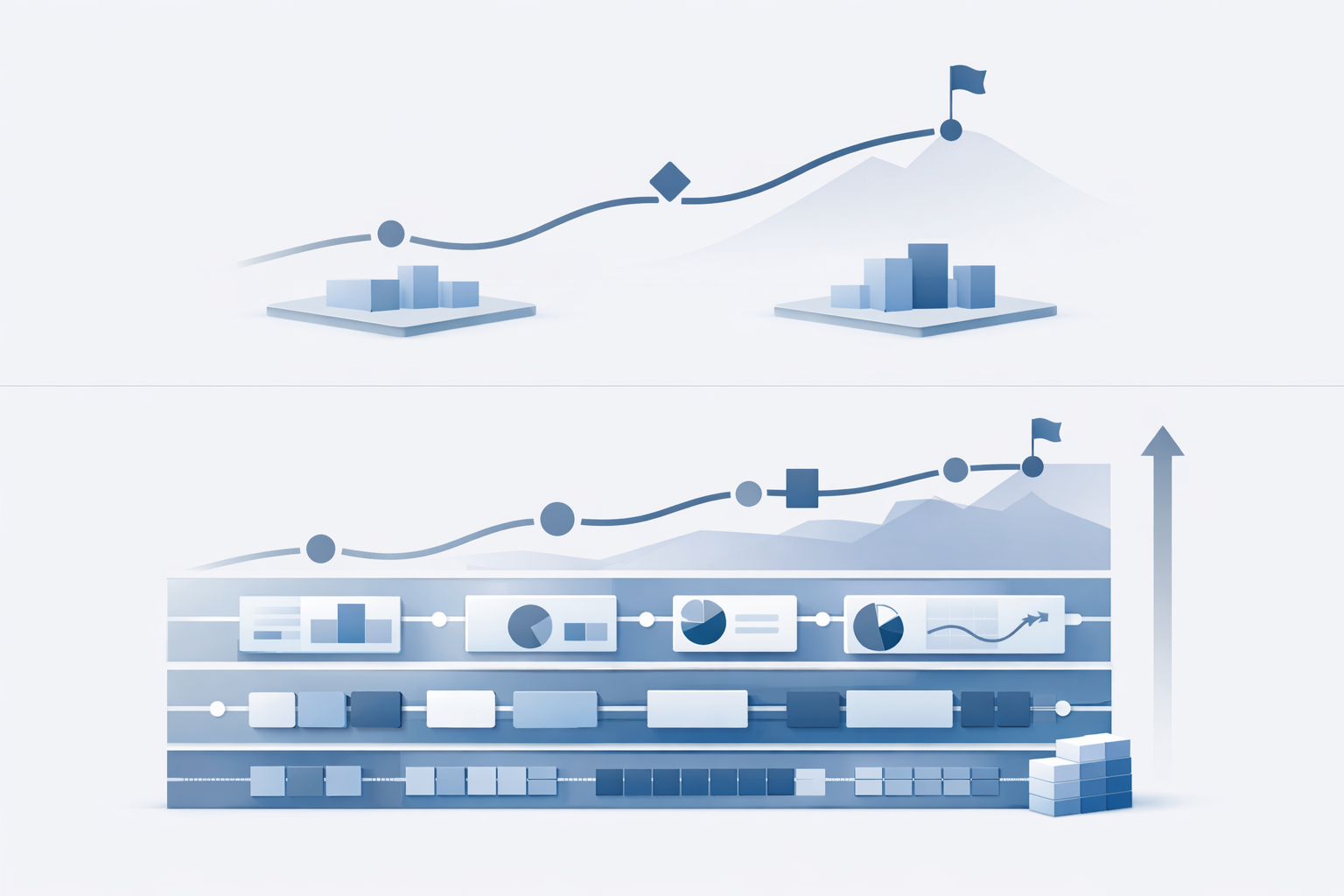
Product roadmaps often look confident on day one – and fragile six months later.
In early stages, teams create roadmaps filled with features, timelines, and ambitious assumptions. But as real users arrive, reality pushes back. Priorities shift, constraints appear, and many roadmaps quietly stop being followed.
This is not a failure of planning.
It is a failure to evolve the roadmap as the product evolves.
A roadmap that works for an MVP will not work for a scaling product. Understanding how and when roadmaps must change is critical for sustainable growth.
Why MVP Roadmaps Break During Scaling
MVP roadmaps are usually built around:
- Assumptions
- Hypotheses
- Learning goals
- Short feedback loops
Scaling roadmaps must deal with:
- Real user behavior
- Operational constraints
- Technical debt
- Team coordination
- Reliability expectations
When teams continue using an MVP-style roadmap after traction, they experience:
- Feature overload
- Missed deadlines
- Engineering burnout
- Loss of strategic focus
- Conflicting priorities across teams
The roadmap didn’t fail – the context changed.
What a Roadmap Is Really For At Each Stage
Before discussing evolution, it’s important to reset expectations.
A roadmap is not:
- A promise of features
- A fixed timeline
- A task list
A roadmap is:
- A decision-making tool
- A prioritization framework
- A communication artifact
- A reflection of strategy
As the product matures, the purpose of the roadmap changes – and so must its structure.
Stage 1: MVP Roadmaps Focus on Learning
At the MVP stage, the roadmap exists to validate assumptions.
What an MVP Roadmap Should Emphasize
- Core problem statements
- Hypotheses to validate
- Minimal feature sets
- Fast iteration cycles
- Clear success and failure criteria
Features are not the goal. Learning is.
What an MVP Roadmap Should Avoid
- Long-term timelines
- Feature-heavy planning
- Premature scalability work
- Dependency-heavy sequencing
A healthy MVP roadmap is intentionally short, flexible, and outcome-driven.
At Rezolut Infotech, MVP roadmaps are framed around questions to answer, not features to ship.
Stage 2: Post-MVP Roadmaps Shift Toward Patterns
Once the MVP is live and users are engaging, the roadmap must evolve.
This stage is about recognizing patterns, not testing ideas blindly.
Key Questions at This Stage
- Which features are actually used?
- Where do users drop off?
- What workflows drive retention?
- What feedback is consistent?
How the Roadmap Changes
- Fewer experiments, more refinement
- Focus on depth over breadth
- UX improvements over new features
- Addressing obvious friction points
This is where many teams make a mistake: they keep adding features instead of strengthening what already works.
Stage 3: From Feature Roadmaps to Outcome Roadmaps
As the product gains traction, roadmaps should transition from feature-based to outcome-based.
Feature-Based Roadmaps Ask
- What should we build next?
Outcome-Based Roadmaps Ask
- What outcome are we trying to improve?
- What constraint is limiting growth?
- What would materially change user behavior?
Outcomes might include:
- Improving activation rate
- Reducing time to value
- Increasing retention
- Improving reliability
- Reducing operational load
Features become tools to achieve outcomes – not the roadmap itself.
Stage 4: Scaling Roadmaps Introduce Non-Feature Work
At scale, a large portion of roadmap work becomes invisible to users – but critical to the product.
This includes:
- Performance improvements
- Reliability and uptime work
- Observability and monitoring
- Architecture evolution
- Security and compliance
- Developer experience improvements
Many scaling failures happen because:
- Leadership underestimates non-feature work
- Roadmaps remain feature-heavy
- Engineering teams accumulate silent debt
A mature roadmap makes infrastructure and quality work explicit, not hidden.
How Roadmaps Should Balance Stakeholders as Products Scale
For CXOs
Roadmaps must:
- Tie initiatives to business outcomes
- Balance growth with risk
- Avoid overcommitting to timelines
- Signal long-term direction clearly
For IT Managers
Roadmaps should:
- Include reliability and cost of work
- Account for operational capacity
- Reduce firefighting over time
- Support predictable delivery
For Developers
Roadmaps must:
- Be realistic
- Reduce constant re-prioritization
- Allow time for refactoring
- Provide clarity on “why,” not just “what.”
A roadmap that satisfies only one group will fail at scale.
Common Roadmap Mistakes During Scaling
Treating the Roadmap as a Contract
Locking roadmaps too tightly removes adaptability—exactly when adaptability is most needed.
Letting Sales or Stakeholders Drive Everything
Roadmaps driven purely by external pressure lose strategic coherence.
Ignoring Engineering Signals
When engineers consistently flag risks, the roadmap must adapt—or velocity will collapse later.
Overloading the Roadmap
More initiatives do not mean more progress. Focus compounds; overload fragments.
How Architecture Influences Roadmap Evolution
Roadmaps and architecture are deeply connected.
- A rigid architecture limits roadmap flexibility
- A modular system supports parallel progress
- Poor foundations force roadmap reshuffles
- Clean boundaries enable realistic planning
This is why early architectural discipline – even in MVPs – pays off during scaling.
Rezolut designs systems so that roadmaps can evolve without constant rewrites, protecting momentum as complexity grows.
Roadmaps in AI-Enabled Products
AI introduces additional roadmap complexity:
- Data readiness
- Model performance
- Cost management
- Trust and explainability
- Iterative improvement cycles
AI features should appear on roadmaps as capabilities and outcomes, not one-off features.
For example:
- “Improve decision accuracy.”
- “Reduce manual processing time.”
- “Increase response consistency.”
This keeps AI aligned with value – not novelty.
How Rezolut Helps Teams Evolve Roadmaps
At Rezolut Infotech, roadmaps are treated as living systems, not static plans.
Rezolut helps teams:
- Redesign roadmaps as products mature
- Shift from feature to outcome thinking
- Balance delivery with sustainability
- Align product, engineering, and business priorities
- Prepare roadmaps for scale and AI adoption
The goal is not to predict the future perfectly – but to remain effective as reality changes.
A Simple Framework for Roadmap Evolution
- MVP stage: Validate assumptions
- Early traction: Strengthen what works
- Growth stage: Optimize outcomes
- Scale stage: Protect reliability and velocity
Each stage demands a different roadmap mindset.
Conclusion
Roadmaps are not meant to be static.
They are meant to evolve alongside the product.
Teams that fail to evolve roadmaps:
- Ship more but achieve less
- Accumulate hidden risk
- Lose alignment as they grow
Teams that evolve roadmaps intentionally:
- Scale faster with fewer surprises
- Protect engineering health
- Align strategy with execution
- Deliver consistent value over time
From MVP to scale, the best roadmaps don’t predict the future – they adapt to it.
With the right strategy, architecture, and technology partner, roadmaps become a powerful tool for growth instead of a source of friction.