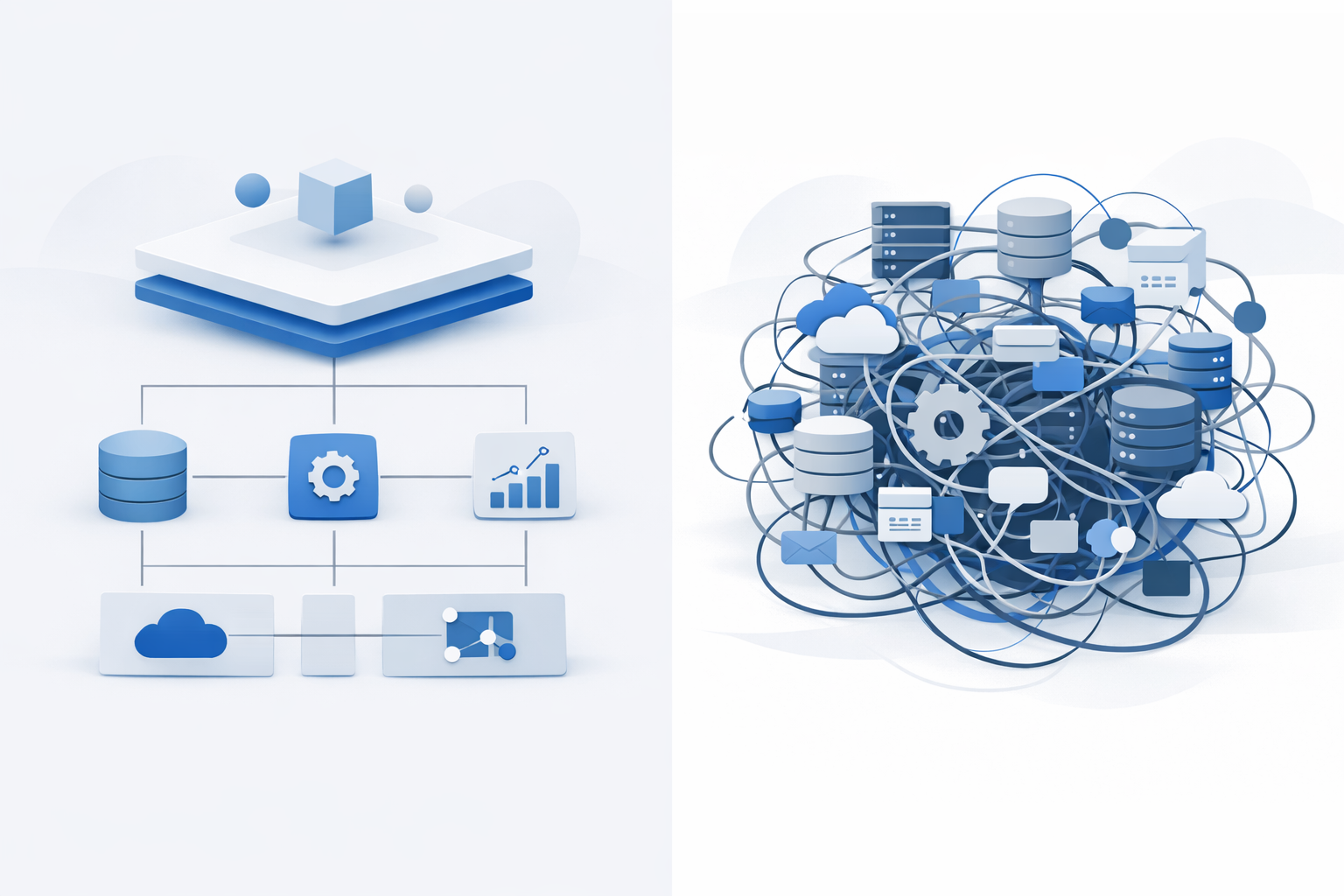
Overengineering is one of the most common – and expensive – mistakes in modern product development.
Teams build systems that are:
- too complex too early,
- difficult to maintain,
- expensive to scale,
- and disconnected from real user needs.
Ironically, most overengineering does not come from poor technical skill. It comes from the absence of a clear product strategy.
When product strategy is weak or undefined, engineering fills the gap with assumptions, abstractions, and “just in case” decisions. This blog explains how a strong product strategy acts as a natural constraint, preventing overengineering while enabling sustainable growth.
What Overengineering Really Is And What It Isn’t
Overengineering is not:
- building quality systems,
- caring about scalability,
- or writing clean code.
Overengineering is:
- solving problems that don’t exist yet,
- optimizing for hypothetical futures,
- adding flexibility without evidence,
- building for scale without demand,
- introducing complexity faster than learning.
It is the mismatch between system complexity and actual product needs.
Why Overengineering Happens So Often
Overengineering usually emerges from good intentions combined with uncertainty.
Common drivers include:
- unclear product direction,
- fear of future rework,
- pressure to “build it right” from day one,
- copying architectures from much larger companies,
- lack of alignment between business and engineering.
When teams don’t know what truly matters, they build everything.
The Role of Product Strategy as a Constraint
Good product strategy does not just inspire teams – it limits them in the right ways.
Product strategy provides clarity on:
- who the product is for,
- What problems matter now?
- What outcomes define success?
- What can be safely ignored (for now).
These boundaries are exactly what prevent overengineering.
When strategy is clear, engineers can confidently choose simpler solutions, knowing they are aligned with real priorities.
How Product Strategy Prevents Overengineering in Practice
1. Strategy Forces Outcome-Driven Thinking
Without a strategy, teams ask:
“What’s the best technical solution?”
With strategy, teams ask:
“What outcome are we trying to achieve?”
This shift is critical.
Outcome-driven strategy:
- discourages unnecessary abstractions,
- prioritizes user impact over elegance,
- aligns effort with measurable value.
If a feature or system component doesn’t move a defined outcome, it’s a candidate for removal or simplification.
2. Strategy Clarifies Time Horizons
Not every system needs to be built for long-term scale immediately.
Product strategy makes time explicit:
- What matters now,
- What can wait,
- And what should never be built.
This helps teams avoid:
- premature microservices,
- complex infrastructure setups,
- heavy automation before stability,
- AI systems without data readiness.
Building for today with awareness of tomorrow is very different from building for every possible tomorrow.
3. Strategy Reduces “Just in Case” Engineering
Overengineering often hides behind flexibility:
- “We might need this later.”
- “This will save us time in the future.”
- “Let’s make it extensible now.”
Product strategy replaces speculation with evidence.
When teams know:
- the core use cases,
- the target users,
- the near-term roadmap,
They can safely avoid building generic frameworks and focus on what is actually used.
4. Strategy Aligns Business and Engineering Decisions
When strategy is missing, engineering decisions become isolated.
This leads to:
- technically impressive systems,
- but unclear business value.
Strong product strategy ensures:
- architecture decisions support growth goals,
- performance work aligns with user impact,
- scalability investments match demand.
Engineering excellence becomes purposeful, not ornamental.
5. Strategy Makes Trade-Offs Explicit
Every technical decision is a trade-off.
Product strategy provides a shared lens to evaluate them:
- speed vs flexibility,
- simplicity vs extensibility,
- cost vs performance,
- innovation vs reliability.
Without a strategy, teams default to:
- personal preferences,
- trends,
- or fear-based decisions.
With strategy, teams choose deliberately – and accept limitations confidently.
Examples of Strategy-Driven Simplicity
- Choosing a modular monolith instead of microservices for early-stage products
- Using RAG instead of agentic AI for informational use cases
- Implementing basic observability before advanced automation
- Building manual workflows before fully automated pipelines
- Shipping a focused MVP instead of a platform
These are not compromises; they are strategic decisions.
How Product Strategy Evolves Without Encouraging Overengineering
Importantly, avoiding overengineering does not mean avoiding growth.
As products mature:
- strategy evolves,
- constraints change,
- Complexity increases intentionally.
The difference is:
- Complexity is added in response to evidence,
- not anticipation.
Strategy ensures systems evolve just in time, not too early.
The Hidden Cost of “Over-Prepared” Systems
Many teams believe they are saving time by building advanced systems early.
In reality, they often pay:
- higher maintenance costs,
- slower iteration,
- more bugs,
- harder onboarding,
- delayed learning.
The opportunity cost of overengineering is often greater than the cost of rebuilding later.
How Rezolut Helps Teams Avoid Overengineering
At Rezolut Infotech, overengineering is treated as a strategy failure, not an engineering one.
Rezolut helps teams:
- define a clear product strategy before scaling technology,
- Align architecture with real product stages,
- avoid premature complexity in AI and infrastructure,
- design systems that evolve incrementally,
- balance speed with long-term maintainability.
The goal is not to build less – but to build only what matters.
A Simple Test to Spot Overengineering
Ask these questions:
- Who uses this today?
- What outcome does this enable?
- What breaks if we remove it?
- Is this solving a current problem or a hypothetical one?
- Can we simplify without losing value?
If answers are unclear, overengineering may already be happening.
Conclusion
Overengineering is rarely caused by bad engineering.
It is caused by an unclear product strategy.
Strong product strategy:
- sets direction,
- creates healthy constraints,
- clarifies priorities,
- and gives teams confidence to choose simplicity.
When strategy leads, engineering becomes sharper, faster, and more impactful.
When strategy is absent, complexity fills the void.
In a world where speed and adaptability matter, the most scalable systems are not the most complex ones – but the ones built with intent.
Product strategy is what makes that possible.