
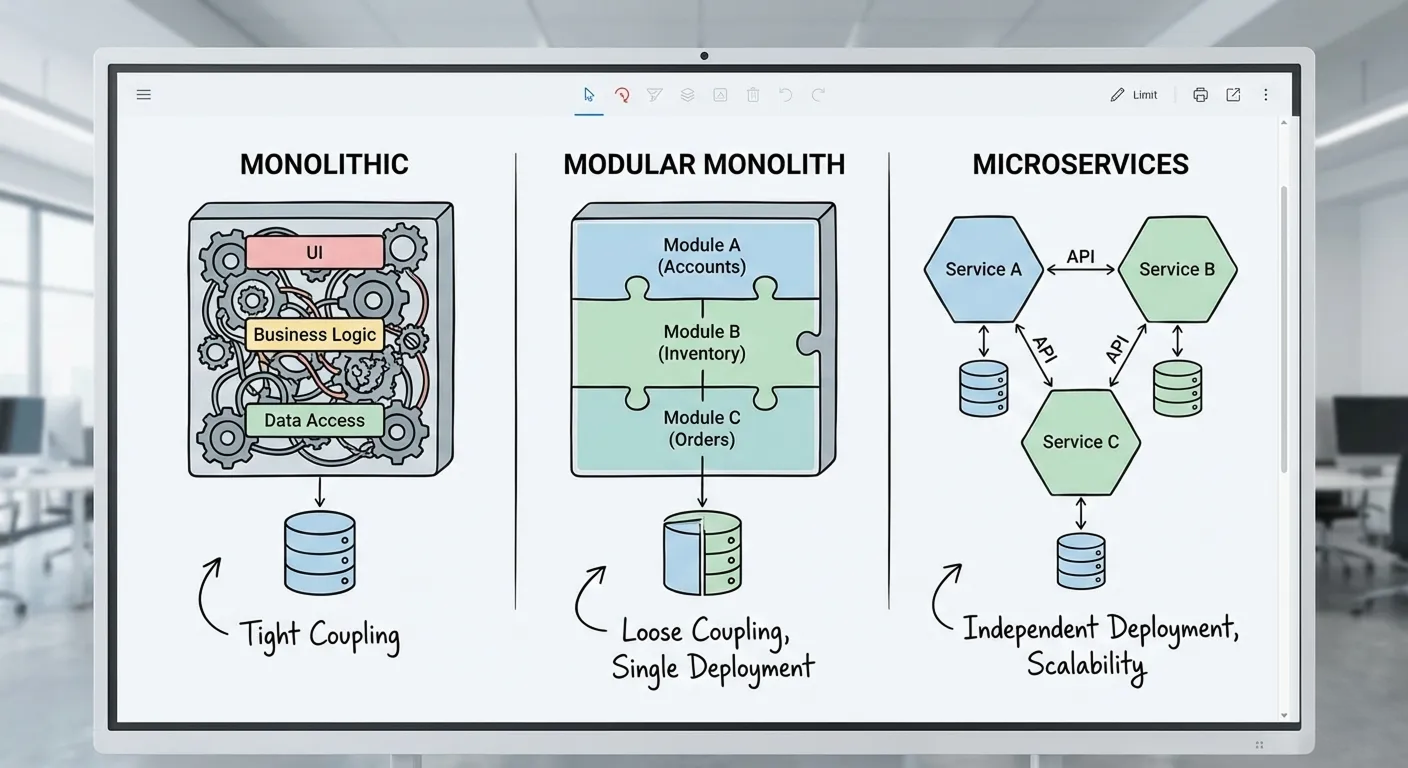
One of the most important technical decisions a startup or scaling company makes is how to structure its application architecture. This decision affects development speed, scalability, cost, team productivity, and long-term maintainability.
Yet many founders face confusion when choosing between:
- Monolithic architecture
- Modular monolith
- Microservices
The problem isn’t that one approach is “right,” and the others are “wrong.” The real challenge is choosing the right architecture for your product’s current stage – without over-engineering or limiting future growth.
What Is a Monolithic Architecture?
A monolithic architecture is a single, unified application where all components – frontend, backend logic, database interactions, authentication, payments, and business rules – are deployed together as one unit.
Key Characteristics
- One codebase
- One deployment pipeline
- Shared database
- Tightly coupled components
Why Startups Often Start Here
Monoliths are simple, fast to build, and easy to reason about – especially for small teams.
Advantages of a Monolith
- Fast initial development
- Simple deployment and testing
- Lower infrastructure complexity
- Easier debugging in early stages
- Cost-effective for MVPs
Limitations of a Monolith
- Harder to scale specific components independently
- A growing codebase becomes tightly coupled
- Slower development as the team grows
- Risk of large-scale outages from small changes
A monolith is not bad architecture – it’s often the right starting point. The problem arises when teams stay with an unstructured monolith for too long.
What Is a Modular Monolith?
A modular monolith is still a single application – but internally it is carefully structured into well-defined modules.
Each module:
- Represents a clear business domain
- Has explicit boundaries
- Minimizes dependencies on other modules
- Can be tested independently
Key Difference from a Traditional Monolith
The difference is discipline and structure, not deployment.
Characteristics of a Modular Monolith
- Single deployment unit
- Clear internal modules (e.g., users, billing, orders)
- Well-defined interfaces between modules
- Independent development within boundaries
- Shared infrastructure but separated logic
Why Modular Monoliths Are Gaining Popularity
They offer the best balance between simplicity and scalability – especially for early- and growth-stage startups.
Advantages of a Modular Monolith
- Faster development than microservices
- Easier refactoring and evolution
- Reduced operational complexity
- Clear ownership and separation of concerns
- Easier transition to microservices later
At Rezolut Infotech, a modular monolith is often the default recommendation for startups building MVPs with a long-term vision.
What Are Microservices?
A microservices architecture splits an application into multiple, independently deployable services. Each service:
- Owns a specific business capability
- Has its own codebase
- Often has its own database
- Communicates with others via APIs or events
Key Characteristics
- Independent deployments
- Independent scaling
- Decentralized data
- Service-to-service communication
- Strong DevOps requirements
Advantages of Microservices
- Independent scaling of components
- Faster releases for large teams
- Fault isolation
- Technology flexibility per service
- Clear ownership for large organizations
Challenges of Microservices
- High operational complexity
- Requires strong DevOps maturity
- More difficult debugging and tracing
- Network latency and failure handling
- Higher infrastructure and tooling costs
Microservices are powerful – but expensive to run and maintain if introduced too early.
Side-by-Side Comparison
| Dimension | Monolith | Modular Monolith | Microservices |
| Deployment | Single | Single | Multiple |
| Internal Structure | Tightly coupled | Strongly modular | Fully independent |
| Scalability | Limited | Moderate – High | Very High |
| Operational Complexity | Low | Low – Medium | High |
| Team Size Fit | Small | Small – Medium | Medium – Large |
| Speed to Build | Fast | Fast | Slower |
| Cost | Low | Low – Medium | High |
| Refactoring Ease | Hard | Easier | Complex |
| Future Migration | Difficult | Easier | Already distributed |
When Should You Choose a Monolith?
A traditional monolith is suitable when:
- You are building an MVP
- The team is small
- Speed and cost matter most
- The domain is still evolving
- You need fast feedback from users
However, this works only if you plan for evolution. A poorly structured monolith can quickly accumulate technical debt.
Rezolut helps teams avoid “big ball of mud” monoliths by introducing minimal structure even at the MVP stage.
When Is a Modular Monolith the Good Choice?
A modular monolith is ideal when:
- You expect growth, but are not at scale yet
- Multiple engineers work in parallel
- Business logic is becoming complex
- You want future microservices without rewriting everything
- You need speed and structure
This architecture:
- Keeps operations simple
- Enables clean code ownership
- Allows selective extraction into microservices later
For most startups between the MVP and growth stage, this is the most pragmatic and cost-effective option.
When Do Microservices Make Sense?
Microservices are appropriate when:
- You have a strong product-market fit
- The organization has multiple teams
- Different parts of the system scale differently
- You need high availability and fault isolation
- You have mature DevOps practices
They are rarely the right starting point.
Rezolut typically recommends microservices only when the business and team structure demand it, not because it is “modern.”
Common Mistakes Founders Make
Starting With Microservices Too Early
This leads to:
- Slower development
- Increased costs
- Debugging complexity
- Team burnout
Treating a Monolith as “Temporary” Without Structure
Temporary code often becomes permanent.
Copying Big-Tech Architectures
What works for Netflix or Uber rarely works for a 10-person startup.
Ignoring Architecture Until It’s Too Late
Architecture decisions compound over time.
Architecture Evolution: The Smart Path
A proven, low-risk evolution path looks like this:
- Monolith (structured) – Fast MVP
- Modular Monolith – Growth and stability
- Microservices (selective) – Scale where needed
This approach:
- Preserves speed
- Controls cost
- Minimizes rewrites
- Aligns with real business growth
Rezolut designs systems with this evolution in mind from day one.
How Rezolut Approaches Architecture Decisions
Rezolut Infotech does not promote a single architecture style. Instead, decisions are driven by:
- Business stage
- Team size and maturity
- Product complexity
- Expected growth patterns
- Budget and timelines
Rezolut’s Architecture Principles:
- Start simple, but structured
- Avoid premature complexity
- Design for change, not prediction
- Balance speed with sustainability
- Enable evolution without rewrites
This ensures architecture supports the business – not the other way around.
Architecture Is a Business Decision, Not Just Technical
Architecture impacts:
- Time to market
- Hiring and onboarding
- Infrastructure costs
- Feature velocity
- Customer experience
Founders who treat architecture as purely technical often pay for it later – through delays, rewrites, and instability.
The right architecture creates leverage.
Conclusion
There is no universally “best” architecture – only the right architecture for your current stage.
- Monolith → best for early speed and MVPs
- Modular Monolith → best balance for most startups
- Microservices → best for large, mature systems
The mistake is not choosing the “wrong” one – it’s choosing too much, too early, or too little, too late.
By making deliberate, stage-appropriate architecture decisions – and partnering with teams who understand both product and engineering – startups can scale with confidence instead of constantly rebuilding.
At Rezolut Infotech, architecture is treated as a growth enabler, not an engineering experiment – helping founders build systems that evolve as fast as their businesses do.