As organizations move beyond AI demos and pilots, a new question is emerging:
Should we use Retrieval-Augmented Generation (RAG) or build Agentic AI systems?
Both approaches are powerful. Both solve real problems. And both are often misunderstood or misapplied.
Choosing the wrong one leads to:
- AI features that don’t scale
- High costs with low ROI
- Fragile automation
- Systems that look impressive but fail in production
What Is Retrieval-Augmented Generation (RAG)?
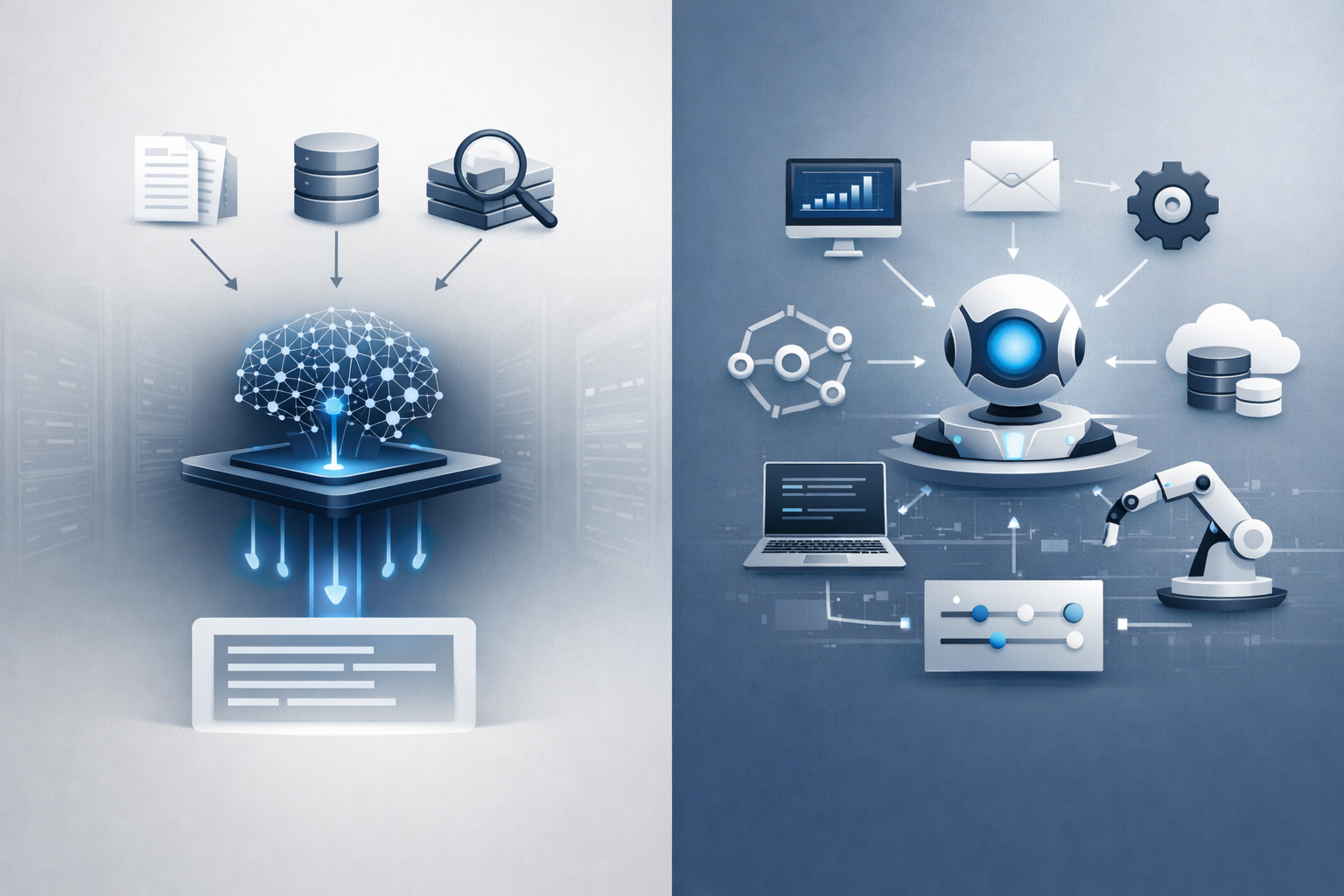
RAG is an AI architecture that combines large language models (LLMs) with external knowledge sources.
Instead of relying only on what the model was trained on, RAG:
- Retrieves relevant information from databases, documents, or APIs
- Injects that information into the prompt
- Generates responses grounded in real data
In simple terms:
RAG improves accuracy by giving the model better context.
What RAG Is Best At
RAG excels when the primary goal is knowledge grounding.
Common RAG use cases include:
- Internal knowledge assistants
- Document-based Q&A systems
- Policy and compliance lookup
- Customer support knowledge bots
- Search and summarization over private data
- Enterprise copilots
RAG helps answer:
“What do we know?”
“Where is the relevant information?”
“How can we explain it clearly?”
Key Strengths of RAG
- Reduces hallucinations
- Keeps AI responses up to date
- Works well with private or proprietary data
- Easier to govern and audit
- Lower operational risk
- Faster to implement
For many organizations, RAG is the safest way to bring AI into production.
Limitations of RAG
RAG is still generative and reactive.
Its limitations include:
- No autonomous decision-making
- No workflow ownership
- No long-term planning
- No action execution
- Dependent on user prompts
RAG systems answer questions, but they don’t run processes.
What Is Agentic AI?
Agentic AI refers to AI systems that can:
- Interpret goals
- Plan steps
- Use tools and APIs
- Maintain state and memory
- Make decisions
- Execute multi-step workflows
Agentic AI moves beyond answering questions to achieving outcomes.
Instead of “Here’s the information,” agentic systems say: “I’ll handle this.”
What Agentic AI Is Best At
Agentic AI is suited for action-oriented systems.
Examples include:
- Automated incident response
- End-to-end customer onboarding
- Order processing and exception handling
- Compliance workflows
- IT and DevOps automation
- Multi-system orchestration
Agentic AI answers:
“What needs to be done?”
“How do we do it?”
“What happens next if this fails?”
Key Strengths of Agentic AI
- Executes complete workflows
- Reduces manual coordination
- Scales operational capacity
- Enables continuous execution
- Automates decision-heavy processes
When done right, agentic AI can fundamentally change how a business operates.
The Core Difference: Knowledge vs Action
The simplest way to understand RAG vs Agentic AI:
| Aspect | RAG | Agentic AI |
| Primary role | Inform | Act |
| Core capability | Knowledge grounding | Autonomous execution |
| Behavior | Reactive | Proactive |
| Decision-making | Minimal | Contextual and goal-based |
| Workflow ownership | Human | AI-led |
| Risk profile | Lower | Higher |
| Time to production | Faster | Slower but deeper |
They are not competing approaches – they solve different problems.
Why Many Teams Choose the Wrong One
Common mistakes include:
Using Agentic AI When RAG Is Enough
This leads to:
- Overengineering
- Higher costs
- Increased risk
- Complex governance needs
Using RAG for Problems That Need Action
This results in:
- Human-in-the-loop overload
- No real operational gains
- AI features that stall at the “assistant” level
The key is matching architecture to intent.
When to Choose RAG
RAG is the right choice when:
- The problem is primarily informational
- Humans remain decision-makers
- Accuracy and trust matter
- Outputs need to be explainable
- You want quick, safe AI adoption
For most organizations, RAG is the correct starting point.
When to Choose Agentic AI
Agentic AI makes sense when:
- Workflows are repeatable
- Decisions follow patterns
- Scale demands automation
- Human coordination is a bottleneck
- Outcomes matter more than explanations
Agentic AI should be introduced incrementally, not all at once.
RAG + Agentic AI: The Real Power Move
The most effective AI systems combine both.
A common pattern:
- RAG provides grounded knowledge
- Agentic AI uses that knowledge to act
Example:
- RAG retrieves policy rules
- Agentic AI applies them to process a request
- System executes actions across tools
- Humans intervene only on exceptions
This layered approach balances power with control.
Architecture Requirements Matter
Agentic AI demands stronger foundations than RAG:
- Modular architecture
- Clean APIs
- Observability and logging
- Infrastructure as Code
- Cost controls
- Clear system boundaries
Without these, agentic systems become fragile.
At Rezolut Infotech, teams are guided to prepare systems first, then introduce autonomy safely – rather than rushing into AI-driven automation.
A Simple Decision Framework
Ask these questions:
- Do users need answers – or outcomes?
- Is human decision-making still central?
- Are workflows stable and repeatable?
- What is the cost of AI mistakes?
- Do we have system readiness?
Your answers will usually point clearly to RAG, Agentic AI, or a hybrid approach.
Conclusion
RAG and Agentic AI are not rivals – they are complements.
- RAG brings truth and context
- Agentic AI brings action and scale
Organizations that succeed with AI understand when to inform and when to automate.
Those that don’t often build impressive demos that never reach real impact.
With the right strategy, architecture, and execution discipline, AI moves from experimentation to infrastructure – and from assistance to real operational leverage.