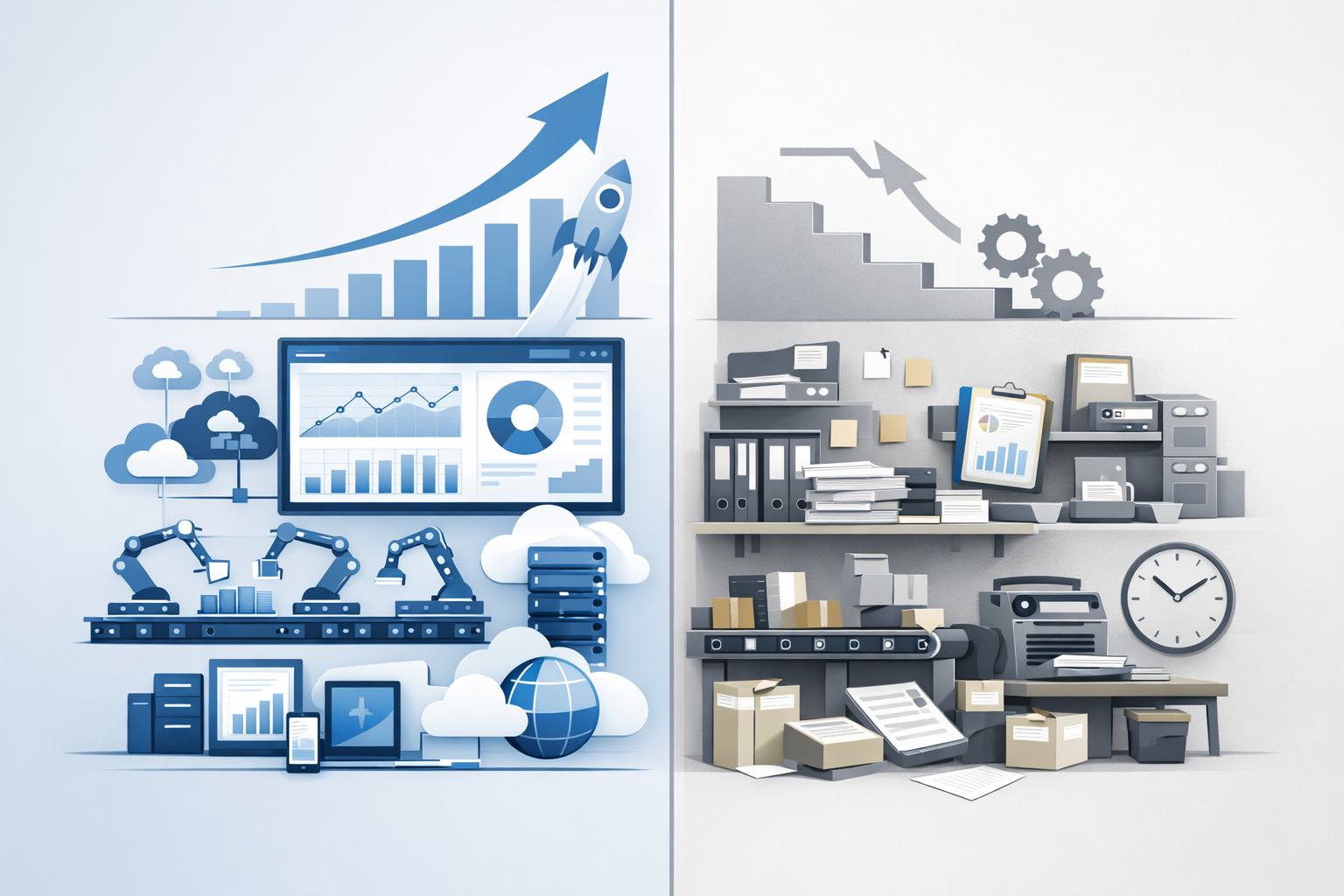
Across industries, one pattern is becoming increasingly clear: tech-driven companies consistently outpace traditional companies in growth, adaptability, and resilience.
This advantage is not limited to Silicon Valley startups or software businesses. Manufacturing firms, financial services companies, logistics providers, healthcare organizations, and retailers are all experiencing the same outcome: those that embed technology into their operations grow faster and respond better to change.
The difference is not about using more tools.
It is about how technology shapes decisions, execution, and scale.
What Defines a Tech-Driven Company
A tech-driven company is not simply one that has:
- a website,
- an ERP,
- or a few digital tools.
A tech-driven company:
- treats technology as a core business capability,
- designs processes around software and data,
- makes decisions informed by real-time insights,
- and builds systems that evolve as the business grows.
In contrast, traditional companies often use technology as a support function, added after processes are already defined.
This distinction explains the growth gap.
Faster Decision-Making Through Data
Tech-driven companies operate with continuous visibility into their business.
They rely on:
- real-time dashboards,
- automated reporting,
- integrated systems,
- and measurable signals.
This allows leadership teams to:
- identify issues early,
- validate assumptions quickly,
- and act before small problems become large ones.
Traditional companies often depend on:
- delayed reports,
- manual aggregation,
- and intuition-driven decisions.
By the time insights surface, opportunities may already be lost.
The speed of decision-making compounds into the speed of growth.
Scalable Operations Without Linear Cost Growth
One of the biggest growth constraints in traditional businesses is linear scaling:
- More customers require more staff,
- More orders require more manual processing,
- More regions require duplicated effort.
Tech-driven companies break this pattern.
They invest early in:
- automation,
- digital workflows,
- reusable platforms,
- and scalable infrastructure.
As a result:
- Revenue can grow faster than headcount,
- Operational costs increase more slowly,
- And complexity is absorbed by systems rather than people.
This operating leverage is a major growth advantage.
Faster Experimentation and Learning
Growth depends on learning what works – and doing it faster than competitors.
Tech-driven companies:
- test ideas through software,
- run experiments with real users,
- measure outcomes objectively,
- and iterate continuously.
This applies to:
- pricing models,
- customer journeys,
- product features,
- marketing channels,
- and internal processes.
Traditional companies often rely on:
- long planning cycles,
- rigid approvals,
- and infrequent change.
By the time an initiative is executed, market conditions may have shifted.
Learning speed becomes a competitive moat.
Better Customer Experience at Scale
Customer expectations have changed across all industries.
Tech-driven companies deliver:
- consistent experiences,
- faster response times,
- personalized interactions,
- and reliable service – even as they scale.
This is possible because:
- customer data is centralized,
- processes are automated,
- systems communicate with each other,
- and feedback loops are built in.
Traditional companies often struggle as they grow:
- service quality becomes inconsistent,
- support costs rise sharply,
- and customer trust erodes.
Growth without experience quality is fragile. Tech-driven companies protect both.
Stronger Alignment Between Strategy and Execution
In tech-driven organizations, strategy is translated directly into systems.
For example:
- A focus on efficiency shows up as automation,
- A focus on speed shows up as streamlined workflows,
- A focus on intelligence shows up as analytics or AI.
Technology becomes the execution layer of strategy.
In traditional organizations:
- strategy often remains abstract,
- execution depends heavily on people,
- and consistency is hard to maintain at scale.
This gap between intent and execution slows growth and increases risk.
Easier Expansion Into New Markets and Models
Tech-driven companies are inherently more adaptable.
They can:
- launch new offerings faster,
- enter new geographies with less friction,
- integrate partners through APIs,
- and experiment with new business models.
Because systems are modular and data-driven, change is incremental – not disruptive.
Traditional companies often face:
- heavy rework,
- duplicated systems,
- and high switching costs.
As markets change faster, adaptability becomes a growth multiplier.
Talent Leverage and Productivity
Tech-driven companies enable people to operate at a higher level.
Instead of spending time on:
- manual coordination,
- repetitive tasks,
- or error correction,
Teams focus on:
- problem-solving,
- innovation,
- and customer impact.
This improves:
- productivity per employee,
- employee satisfaction,
- and retention.
Traditional companies often scale by adding more people rather than improving systems – eventually hitting coordination limits.
AI and Automation as Growth Accelerators
Tech-driven companies are better positioned to adopt AI and automation meaningfully.
Because they already have:
- clean data flows,
- digital processes,
- and integrated systems,
AI can be applied to:
- decision support,
- operational optimization,
- customer service,
- and internal productivity.
Traditional companies often struggle to adopt AI because underlying systems are fragmented or manual.
AI amplifies strong foundations – it does not fix weak ones.
Growth Is More Predictable and Sustainable
Rapid growth without control creates instability.
Tech-driven companies grow faster and more predictably because:
- Systems provide visibility,
- Risks surface earlier,
- Scaling bottlenecks are easier to identify,
- And corrective action is faster.
This predictability builds confidence with:
- Customers,
- Partners,
- And investors.
Sustainable growth is ultimately more valuable than short-term acceleration.
The Role of Technology Partners in Becoming Tech-Driven
Becoming tech-driven is not about buying tools – it is about building the right systems in the right order.
This is where experienced technology partners matter.
At Rezolut Infotech, companies are supported in:
- evolving from manual to digital workflows,
- building scalable product and platform foundations,
- aligning technology decisions with business goals,
- avoiding premature complexity,
- and using AI and automation where they create real value.
The focus is not transformation for its own sake, but growth enablement.
Traditional vs Tech-Driven Is No Longer a Choice
In most industries, the gap between tech-driven and traditional companies is widening.
This does not mean every company must become a software company.
It means every growth-oriented company must think like one.
Those that don’t risk:
- slower response to change,
- higher operating costs,
- weaker customer loyalty,
- and reduced competitiveness.
Those who do gain compounding advantages over time.
Conclusion
Tech-driven companies grow faster because they:
- decide faster,
- learn faster,
- scale more efficiently,
- and adapt more easily to change.
Technology is no longer a support function; it is the engine of modern growth.
The real question for businesses today is not:
“Should we become tech-driven?”
It is:
“How quickly can we build the foundations to grow that way?”
With the right strategy and the right technology partner, that shift becomes achievable – and transformative.