Architecting Production Ready LLM Systems

Large Language Models (LLMs) have moved rapidly from experimentation to real business use. Many organizations now have working demos, internal tools, or early customer-facing features powered by LLMs. Yet very few of these systems are truly production-ready. The reason is rarely the model itself. The real challenge is architecture. LLMs place fundamentally different demands on […]
RAG vs Agentic AI

As organizations move beyond AI demos and pilots, a new question is emerging: Should we use Retrieval-Augmented Generation (RAG) or build Agentic AI systems? Both approaches are powerful. Both solve real problems. And both are often misunderstood or misapplied. Choosing the wrong one leads to: What Is Retrieval-Augmented Generation (RAG)? RAG is an AI architecture […]
Agentic AI vs Generative AI

Artificial intelligence discussions today are dominated by generative models – chatbots, content generators, copilots, and assistants. While these tools have transformed how teams work, they represent only one stage of AI evolution. The next major shift is Agentic AI. Many organizations use the terms “Generative AI” and “Agentic AI” interchangeably. This is a mistake. They […]
Why Every Startup Should Adopt Infrastructure as Code (IaC)

For many startups, infrastructure decisions begin as quick fixes. A server is provisioned manually, a database is configured once, and changes are made as needed to “keep things running.” This approach often works – until it doesn’t. As products gain users and teams grow, manual infrastructure becomes a hidden bottleneck. Environments drift, deployments become risky, […]
How Product Strategy Aligns Technology With Business Growth

Many companies invest heavily in technology but struggle to see proportional business growth. Systems are built, tools are deployed, and teams are busy – yet outcomes remain underwhelming. The issue is rarely a lack of technology.It is a lack of product strategy. Product strategy is the bridge between business intent and technology execution. Without it, […]
Why Tech-Driven Companies Scale Faster Than Traditional Companies

Across industries, one pattern is becoming increasingly clear: tech-driven companies consistently outpace traditional companies in growth, adaptability, and resilience. This advantage is not limited to Silicon Valley startups or software businesses. Manufacturing firms, financial services companies, logistics providers, healthcare organizations, and retailers are all experiencing the same outcome: those that embed technology into their operations […]
How Roadmaps Should Evolve From MVP to Scale

Product roadmaps often look confident on day one – and fragile six months later. In early stages, teams create roadmaps filled with features, timelines, and ambitious assumptions. But as real users arrive, reality pushes back. Priorities shift, constraints appear, and many roadmaps quietly stop being followed. This is not a failure of planning.It is a […]
Understanding MVP and MLP in Product Development
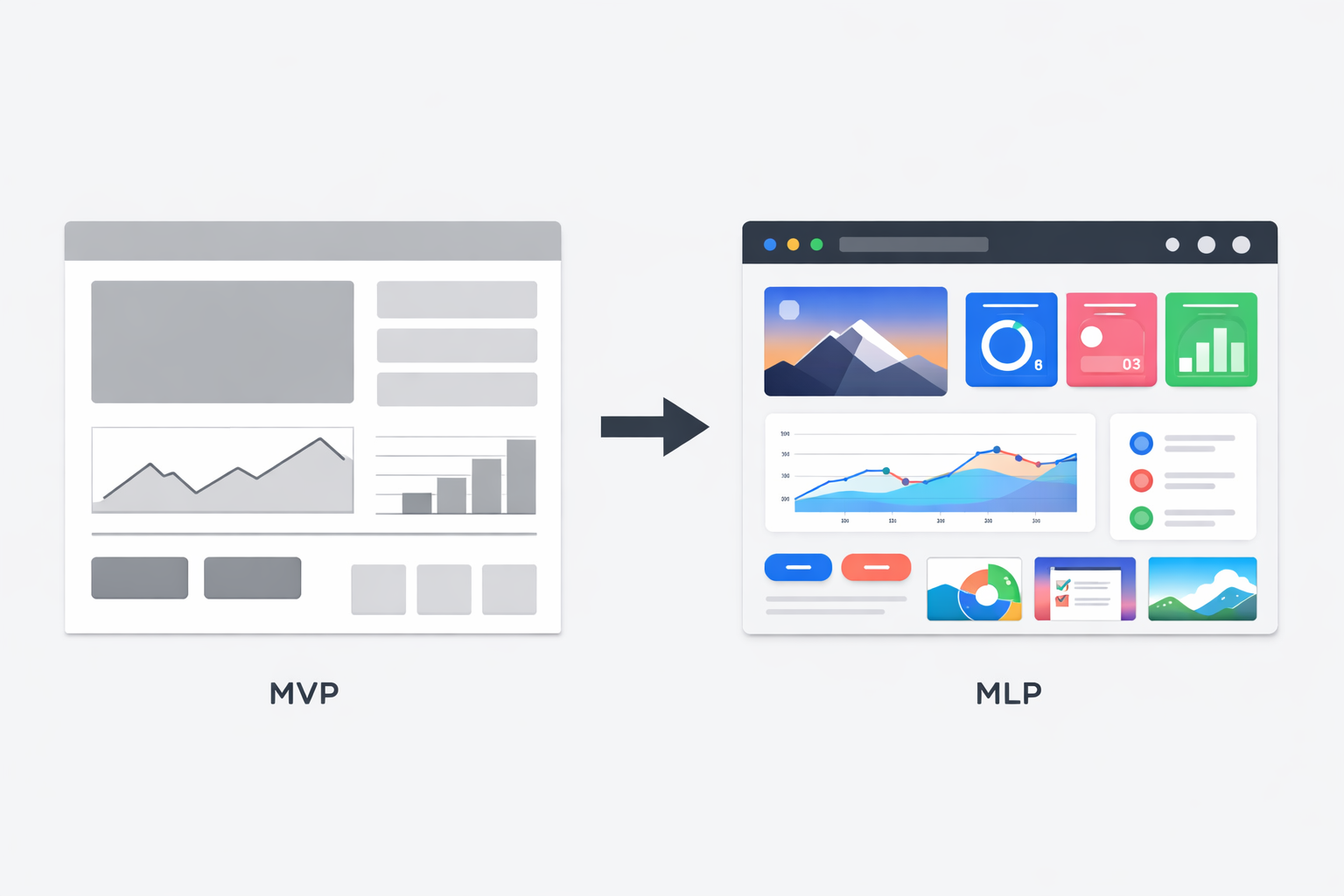
Many teams believe that launching an MVP is the end of early product development. In reality, it is only the beginning. This misunderstanding often leads to stalled growth, weak adoption, and products that technically work but fail to gain momentum. This is where the distinction between MVP (Minimum Viable Product) and MLP (Minimum Lovable Product) […]
AI Tools That Improve Developer Productivity

Developer productivity has always been a competitive advantage. Teams that ship faster, fix issues earlier, and maintain cleaner systems consistently outperform those that don’t. Today, AI is reshaping how developers work – but not all AI tools actually improve productivity. Some tools genuinely reduce cognitive load and repetitive work. Others add noise, false confidence, or […]
What Prototyping Really Means in Product Development

In product development, prototyping is often misunderstood. Some teams treat it as a quick design exercise. Others skip it entirely to “save time.” And many confuse prototypes with MVPs, assuming they serve the same purpose. In reality, prototyping plays a very specific and critical role in building successful products. When used correctly, it reduces risk, […]